



















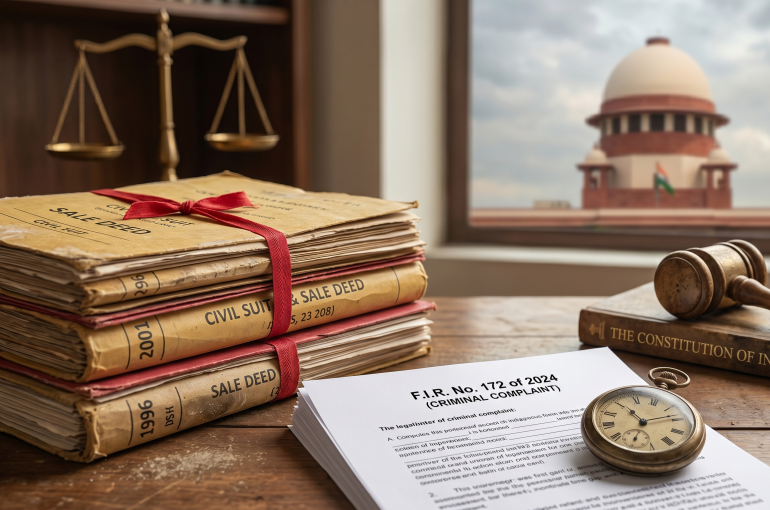
SUPREME COURT HOLDS THAT CIVIL AND CRIMINAL REMEDIES CAN BE INVOKED FOR SAME CAUSE PROVIDED THERE IS NO UNREASONABLE TIME GAP

INTRODUCTION
The Hon’ble Supreme Court of India examined a case concerning a 23-year delay in starting criminal proceedings after a long-standing civil dispute, namely Nazibul Rahim Khan & Ors. v. State of Uttar Pradesh & Anr., 2026 INSC 619. This decision was made on March 25, 2026. The Court, consisting of Hon’ble Justices Ahsanuddin Amanullah and R. Mahadevan, stated that a person who has suffered an injury can use both civil and criminal remedies at the same time for the same issue, but there should not be an unjustified or very long time delay between the two. The Court was concerned about the Hon’ble High Court not cancelling the delayed criminal case, suggesting that such a delay might indicate the use of pressure tactics rather than a real attempt to get justice.
BRIEF FACTS
- This case involves a land dispute over 13 acres, where Respondent No. 2 claims that the land was transferred via a forged Power of Attorney using an impersonator.
- Respondent No. 2 initially filed a civil lawsuit (O.S. No. 259 of 2001) in the year 2001, seeking a Permanent Injunction and the cancellation of a Sale Deed dated February 2, 1996.
- Although Respondent No. 2 was aware of these alleged criminal acts since at least 2001, she filed a FIR No. 172 of 2024 only on March 10, 2024.
- After the investigation, the Police filed a charge-sheet and the Ld. Trial Court considered the case, summoning the Appellants for trial.
- The Appellants attempted to challenge the charge-sheet and related proceedings before the Hon’ble High Court of Judicature at Allahabad, Lucknow Bench, under Section 482 of the Code of Criminal Procedure, but their application was denied.
ISSUES OF LAW
The Hon’ble Supreme Court addressed two key legal questions:
- Whether a 23-year delay in filing a FIR for allegations already covered in a long-running civil case constitutes an abuse of legal process.
- Whether the High Court made a mistake in not using its inherent powers under Section 482 of the CrPC to cancel a delayed and potentially vexatious criminal case.
ANALYSIS OF THE JUDGMENT
The Hon’ble Supreme Court criticized the initiation of criminal proceedings after a very long delay of over two decades. The Apex Court made the following important observations:
- Simultaneous proceedings: The Court acknowledged that civil and criminal actions can take place at the same time if based on the same facts and reasons.
- Importance of timeliness: The Court emphasized that when someone uses both civil and criminal remedies, there should not be a long and unreasonable gap between the two.
- Assessing genuine intent: The Supreme Court pointed out that a very long delay in filing criminal charges raises questions about the authenticity of the case. It suggested that such delays may indicate whether the criminal action is a genuine effort to achieve justice or a method to put pressure on the other party in the civil case.
- No valid reason for the delay: The Court rejected Respondent No. 2’s claim that her age and being a childless widow justified the 23-year delay. The Apex Court noted that she was approximately 55 when she started the civil case in 2001 and was not helpless, as her brother was assisting her in the proceedings.
- Precedent on harassing litigation: The Court referred to the case of Kishan Singh v. Gurpal Singh, (2010) 8 SCC 775, which states that people who are not successful in civil cases cannot use criminal courts to harass or seek revenge. The Court observed that without a proper reason, an excessive delay in filing a FIR may be considered improper.
CONCLUSION
The Hon’ble Supreme Court allowed the criminal appeal, as the Appellants adequately showed a case for intervention.
Therefore, the Hon’ble Supreme Court overturned the Hon’ble High Court’s decision and fully cancelled FIR No. 172 of 2024, along with all subsequent actions. This ruling reinforces the principle that although individuals can use both civil and criminal remedies, courts must ensure that the criminal justice system is not misused as a tool for harassment or persecution due to unexplained and prolonged delays.
ANIKET KUMAR PARCHA
Legal Associate
The Indian Lawyer & Allied Services
Editor’s Comments
It is a known fact that in India many a times a litigant file a criminal case on the opposite side to put pressure to either settle the matter or as revenge. While it is accepted by the law that both civil and criminal case can be filed for the same cause of action, the litigant initiating both remedies must justify how the case has both a civil and a criminal angle. In the judgment above it seems that the filing of a criminal case after a delay of 23 years was only to pressurize the other side and not a genuine case. In many such cases where a false criminal case has been filed the court can impose costs for wasting the time of the court.
Sushila Ram Varma
Advocate and Chief Consultant
The Indian Lawyer & Allied Services
Please log onto our YouTube channel, The Indian Lawyer Legal Tips, to learn about various aspects of the law. Our latest Video, titled “Civil Trials in India|Episode -60|Sushila Ram Varma Advocate#law #civiltrials #lawyerindia” can be viewed at the link below :

Leave a Reply