



















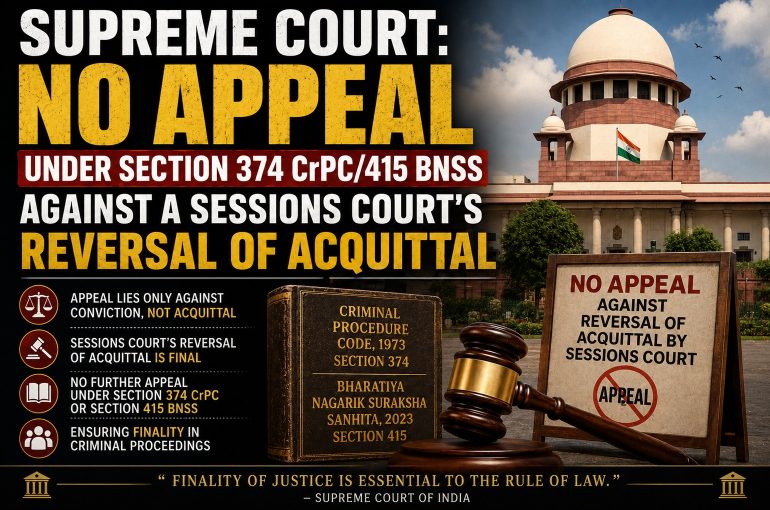
SUPREME COURT: NO APPEAL UNDER SECTION 374 CrPC/415 BNSS AGAINST A SESSIONS COURT’S REVERSAL OF ACQUITTAL

Vishnu Kumar Gupta v State of Madhya Pradesh and ANR. Criminal Appeal arising out of SLP (Crl.) No. 13891 of 2025| 2026 INSC 770 Supreme Court of Indian| Coram: Aravind Kumar, J. and Prasanna B. Varale, J.| Decided on 20.07.2026
BRIEF FACTS OF THE CASE
The Complainant lodged a Zero FIR under Sections 498-A, 323, 34 Indian Penal Code, 1860 and Sections 3 and 4 of the Dowry Prohibition Act, 1961 against her husband and his parents. After trial, the Judicial Magistrate First Class, Bhind, acquitted all three accused on 20.12.2024 citing inconsistencies in the Complainant’s testimony and absence of signs of corroboration. The Complainant appealed the acquittal under Section 378 CrPC before the Seventh Additional Sessions Judge, Bhind, who, on 27.05.2025, affirmed the acquittal of the parents but reversed the acquittal of the husband, convicting him under Section 498-A IPC and Section 4 of Dowry Prohibition Act.
The Husband then appealed this conviction before the High Court of Madhya Pradesh under Section 374 CrPC. On 11.07.2025, the High Court dismissed the appeal on the ground of maintainability, holding that Section 374 applies only to convictions recorded in exercise of original trial jurisdiction and separately invoked Rule 48 of Chapter X of the Madhya Pradesh High Court Rules, 2008( Rules) for non-surrender. The Accuse, Vishnu Kumar Gupta, appealed to the Supreme Court of India.
SUBMISSIONS
The Appellant argued that the Sessions Court’s judgement was his first conviction, that the Trial Court had acquitted him and that denial of an appellate remedy violated Article 21. He relied on the phrase “convicted on a trial” in Section 374, arguing it extends to any conviction founded on trial record. The State argued that neither the CrPC nor BNSS provides for a second statutory appeal against an appeal conviction and that the only remedy in revision under Sections 397 and 401 CrPC.
ANALYSIS BY THE COURT
The Supreme Court answered the question negatively and dismissed the appeal. The Court held that “Appeal is a creature of statute” and that no appeal lies except as expressly provided. Courts cannot read into a remedy.
Surveying precedents including State of Bihar v. Ram Naresh Pandey and Another AIR 1957 SC 389, V.C. Shukla v. State through C.B.I. 1980 SCC OnLine SC 158 (cited in the judgment as 1980 SCC Crl. 695), Union of India and Others v. Major General Madan Lal Yadav (Retd.) (1996) 4 SCC 127, “Common Cause”, A Registered Society through its Director v. Union of India and Others (1996) 6 SCC 775 and Hardeep Singh v. State of Punjab and Others (2014) 3 SCC 92 (Constitution Bench), the Court held that a trial commences with framing of charges and concludes with judgement and sentence by the Trial Court. On Conviction, it ends with sentence and on acquittal, it ends with the order of acquittal.
The expression “on a trial held by” on section 374, means an appeal only from the court that itself conducted its trial, from framing of charges to sentence. A Sessions Court deciding a Section 378 appeal exercises appellate, not trial, jurisdiction and a conviction recorded there is not one “on a trial held by” that court.
The Appellant’s argument was rejected. The doctrine that an appeal continues the original proceedings and the doctrine of merger, govern the legal consequences of an appeal but do not convert an appellate court into a trial court or change the character of its jurisdiction.
The case of Arun Sharma got overruled. The reasoning in Arun Sharma, that an appellate conviction is a conviction “on a trial” because an appeal continues the trial, does not follow from the continuation doctrine and does not lay down correct law. It was expressly overruled.
Appellate power under Section 386 and 391 CrPC permits full re-appreciation of evidence and independent findings, per Chandrappa v. State of Karnataka. Revisional power under Sections 397 and 401 CrPC is supervisory and discretionary, confined to jurisdictional error, illegality, or perversity causing miscarriage of justice, per Amit Kapoor v. Ramesh Chander.
The only remedy for a person convicted for the first time by an appellate court is revision under Section 397 and 401 CrPC. Section 401(1) allows the High Court, in revision, to exercise the powers of an appellate court and exists precisely for this situation. The Bar in Section 401(3) prevents converting an acquittal into a conviction but does not restrict the revisional court from examining evidence in detail or acquitting where a conviction is unsustainable.
CONCLUSION
Direction to High Courts that was given was that such revisions stand on a different footing from ones arising out of concurrent findings, and High Courts should exercise revisional jurisdiction under Section 401(1) more liberally in these cases, invoking appellate powers where warranted. The Court declined to examine the validity of Rule 48 as that issue was pending separately before the High Court.
The appeal was dismissed, with liberty granted to the appellant to file a revision against the Sessions Court’s judgment dated 27.05.2025 in Criminal Appeal No. 3/2025.
Shomdeepta Chanda
Associate
The Indian Lawyer & Allied Services
EDITOR’S COMMENTS
In Criminal Law, the courts always follow the provisions to the letter and no court can decide to do away from the process that has been laid down in the law. The Appellant took the wrong path and should have filed the criminal revision before the concerned High Court challenging the conviction under 498-A IPC and Section 4 of the Dowry Prohibition Act. The Court in its revisional power can reappreciate evidence and set aside the conviction if there is reason to do so. Since this was the Appellant’s first conviction the High Court could look at the illegality or impropriety of the Trial Court order as per Amit Kapoor v. Ramesh Chander where the Supreme Court had held that the high courts should apply the standard liberally in the cases of first conviction. Hence approaching a wrong court in a criminal matter does not serve any purpose.
Sushila Ram Varma
Advocate and Chief Consultant
The Indian Lawyer & Allied Services
Watch our Latest Video. Click on the link below

Leave a Reply