



















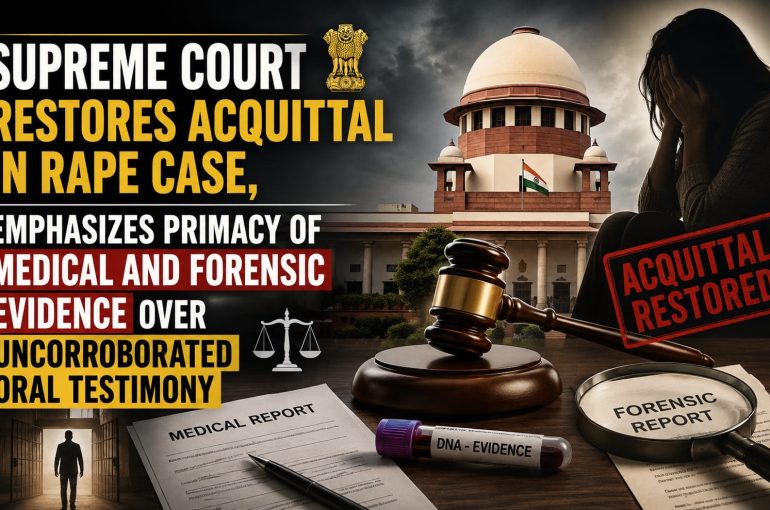
SUPREME COURT RESTORES ACQUITTAL IN RAPE CASE, EMPHASIZES PRIMACY OF MEDICAL AND FORENSIC EVIDENCE OVER UNCORROBORATED ORAL TESTIMONY

INTRODUCTION
The Hon’ble Supreme Court of India recently addressed the evidentiary value of forensic and medical reports versus oral testimonies in a criminal trial. In Ram Singh v. The State of Himachal Pradesh (Criminal Appeal No.1052 of 2016), decided on August 11, 2026, a two-judge Bench comprising Hon’ble Justices Ujjal Bhuyan and Atul S. Chandurkar delivered a crucial verdict. The Court made it clear that a conviction cannot rely on oral statements when contradictory medical and forensic evidence creates a grave doubt about the prosecution’s case.
BRIEF FACTS
The dispute originated from an incident on June 28, 2009, where the Appellant was accused of committing an offence punishable under Section 376 of the Indian Penal Code, 1860, against the informant’s four-and-a-half-year-old daughter. The informant alleged that her daughter returned crying from the Appellant’s residence and stated she had been sexually assaulted. The mother claimed there were bloodstains on the Victim’s clothes, which she subsequently washed before lodging a First Information Report (FIR) that same evening at 17.45 hours.
The trial Court acquitted the Appellant on January 12, 2010, observing that the lack of injury on the Victim dented the prosecution’s case and that the witness depositions did not inspire confidence due to various discrepancies. However, on June 03, 2016, the Division Bench of the Himachal Pradesh High Court reversed this acquittal, viewing the inconsistencies as immaterial. The High Court convicted the Appellant and sentenced him to ten years of rigorous imprisonment with a fine of ₹50,000/-. Aggrieved by the High Court’s Order, the Appellant preferred a Criminal Appeal before the Supreme Court.
ISSUES OF LAW
The Apex Court focused its evaluation on fundamental legal questions regarding evidence:
Can an appellate court reverse a well-reasoned trial court judgment of acquittal without considering the contradictory final medical and forensic science laboratory (FSL) reports?
Is oral testimony regarding physical injuries and bloodstains sufficient for a conviction when preliminary and final medical examinations, along with chemical tests, completely rule out their existence?
ANALYSIS OF THE JUDGMENT
The Supreme Court took a sharp, principled stance against ignoring scientific evidence, laying down the following key observations:
Absence of Medical Evidence of Assault: The Bench highlighted that the preliminary medical examination of the Victim, conducted within twelve hours of the alleged incident, showed no sign of any injury, inflammation, redness, bruising or laceration. The Medical Officer noted that the hymen was intact and the final opinion given on September 05, 2009, concluded that there was no evidence to suggest penetration had taken place.
Contradictory Forensic Findings: The Apex Court noted a significant contradiction regarding the alleged bloodstains. While the Victim and her mother firmly stated there was blood on the clothes, the FSL report dated August 29, 2009, confirmed that no blood or semen was detected on the Victim’s clothes following a ‘Benzidine test’. Furthermore, tests performed on a chatai and baithak recovered from the Appellant’s house also failed to detect any blood or semen.
Discrepancies in the Place of Occurrence: The Court observed a material doubt regarding the crime scene. The Victim claimed she was assaulted on a cot, yet the Investigating Officer stated the alleged incident took place in the kitchen, where there was admittedly no cot or bed.
Failure of the High Court: The Supreme Court strongly criticized the High Court for overturning the acquittal by relying on the prosecution’s oral evidence while entirely failing to refer to the Final Medical Report or the report of the FSL. The Court emphasized that the entire prosecution evidence must be taken into consideration before arriving at any conclusion.
CONCLUSION
Finding that the material on record fell short and created a serious doubt about the prosecution’s version, the Hon’ble Supreme Court allowed the Criminal Appeal. The Court set aside the High Court’s judgment dated June 03, 2016, restored the trial Court’s acquittal of the Appellant and directed that his bail bonds stand cancelled.
ANIKET KUMAR PARCHA
Legal Associate
The Indian Lawyer & Allied Services
Editor’s Comments
Under the new law Rape is an offence that attracts a severe punishment. In all criminal matters a person is deemed to be an accused only if the crime is proved beyond reasonable doubt. In this case despite a rape case been lodged the Complainant fail to produce indisputable evidence that would point to the commission of the alleged offense. The Supreme Court therefore correctly held that only corroborative evidence was not enough to convict the Accused.
Sushila Ram Varma
Advocate and Chief Consultant
The Indian Lawyer & Allied Services
Please log onto our YouTube channel, The Indian Lawyer Legal Tips, to learn about various aspects of the law. Our latest Video, titled “What to do when false FIR/case filed against you? How to deal with false cases” can be viewed at the link below:
Watch our latest video on Maintenance

Leave a Reply