



















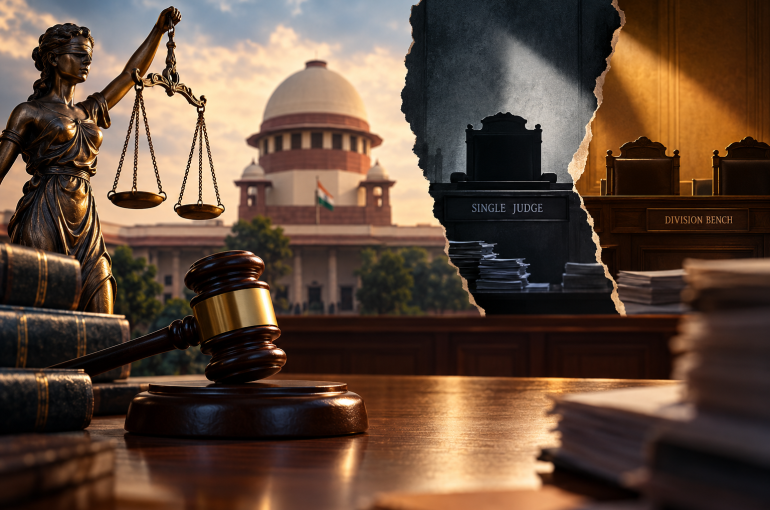
THE LIMITS OF APPELLATE POWER: WHEN A DIFFERENT VIEW IS NOT ENOUGH

INTRODUCTION
In R. Saravanan v. Periyar University, represented by its Registrar & Ors., 2026 INSC 1136, the Supreme Court of India, comprising Justice Shree Chandrashekhar and Justice Prashant Kumar Mishra, delivered its Judgment on 16 October 2026. The decision addresses an important question concerning the appellate jurisdiction of High Courts: can a Division Bench reverse a decision of a Single Judge merely because it disagrees with the latter’s assessment of the case? The Judgment clarifies the limits of interference in intra-court appeals and reinforces the need for judicial restraint.
BRIEF FACTS
- Saravanan, a Deputy Registrar at Periyar University, was removed from service following disciplinary proceedings arising from allegations of misconduct, including misuse of official position and possession of assets allegedly beyond his known sources of income.
Challenging his removal, Saravanan approached the Madras High Court under Article 226 of the Constitution. The Single Judge found that the findings in the Inquiry Report lacked adequate evidentiary support and interfered with the punishment imposed by the University.
The University appealed under Clause 15 of the Letters Patent. The Division Bench reconsidered the evidence and restored the order of removal. Aggrieved by this reversal, Saravanan approached the Supreme Court, questioning whether the Division Bench had exceeded the permissible limits of its appellate jurisdiction.
ISSUES OF LAW
The principal issue before the Supreme Court was whether a Letters Patent Bench could interfere with a decision of a Single Judge exercising writ jurisdiction merely because it arrived at a different conclusion on the facts or the applicable law.
The Court also considered the extent to which a Writ Court may examine disciplinary findings and the circumstances in which an Appellate Bench can legitimately interfere with the exercise of that jurisdiction.
ANALYSIS OF THE JUDGMENT
The Supreme Court began by examining the nature of Judicial Review in disciplinary proceedings. It reiterated that a court exercising jurisdiction under Article 226 does not ordinarily sit as an appellate authority over a departmental inquiry. It is not expected to reassess every piece of evidence or substitute its own conclusions for those of the disciplinary authority.
However, this limitation does not prevent judicial intervention where the findings are unsupported by evidence, are perverse, or rest on speculations and legally impermissible inferences. The distinction is between questioning the manner in which evidence has been appreciated and examining whether there is any legally sustainable material supporting the finding in the first place.
In the present case, the Single Judge had found that the conclusions supporting Saravanan’s removal lacked a proper evidentiary foundation. The Supreme Court considered this a legitimate exercise of writ jurisdiction rather than an impermissible reappreciation of evidence. The fact that the University disagreed with that assessment did not, by itself, justify appellate interference.
The Court then examined the scope of a Letters Patent Appeal. Such an Appeal undoubtedly confers appellate jurisdiction upon the Division Bench, but that jurisdiction is not unrestricted. An Appellate Bench must give due weight to the decision of the Single Judge, particularly where the latter has exercised judicial discretion on relevant considerations and has delivered a reasoned decision.
Interference becomes justified when there is a clear and demonstrable error that materially affects the outcome or when the findings are so unreasonable that they cannot be sustained. A minor error, a difference in interpretation, or the possibility of reaching another conclusion is not sufficient. The appellate jurisdiction is intended to correct substantial judicial error, not to provide an unrestricted opportunity to reconsider every aspect of a dispute.
Applying these principles, the Supreme Court found that the Division Bench had reconsidered the material from the disciplinary inquiry and substituted its own assessment without identifying adequate grounds for overturning the Single Judge’s decision. In doing so, it exceeded the permissible limits of interference under Clause 15 of the Letters Patent.
The Judgment is significant because it maintains a balance between the authority of an Appellate Bench and the need for judicial consistency. It does not make the findings of a Single Judge immune from scrutiny. Rather, it requires the Appellate Court to identify cogent reasons before disturbing a decision that is otherwise reasoned, just and legally sustainable.
The ruling also carries implications for service jurisprudence. Employees facing disciplinary action remain subject to the findings of competent authorities, but those findings cannot escape judicial scrutiny when they lack an evidentiary basis. Equally, an Appellate Court cannot restore a punishment merely by drawing different inferences from the same material without demonstrating a legally sustainable reason for doing so. The Supreme Court set aside the Division Bench’s Judgment and restored the Single Judge’s decision. The Appeal was allowed, with no order as to costs.
SARTHAK KALRA
Senior Legal Associate
The Indian Lawyer & Allied Services
EDITOR’S COMMENTS
The Judgment reinforces a fundamental principle of Appellate Review: disagreement alone is not a ground for reversal. While Appellate Courts possess the authority to correct errors, that power must be exercised with restraint and supported by cogent reasons. By clarifying the limits of interference under Clause 15 of the Letters Patent, the Court has reaffirmed the importance of judicial discipline, reasoned decision-making and fairness in administrative proceedings.
SUSHILA RAM VARMA
Advocate & Chief Consultant
The Indian Lawyer & Allied Services
Please log onto our YouTube channel, The Indian Lawyer Legal Tips, to learn about various aspects of the law. Our latest Video, titled “CJP protest: Supreme Court ka Bada Faisla” can be viewed at the link below:
https://www.youtube.com/watch?v=TzB1rbG9_rs

Leave a Reply