



















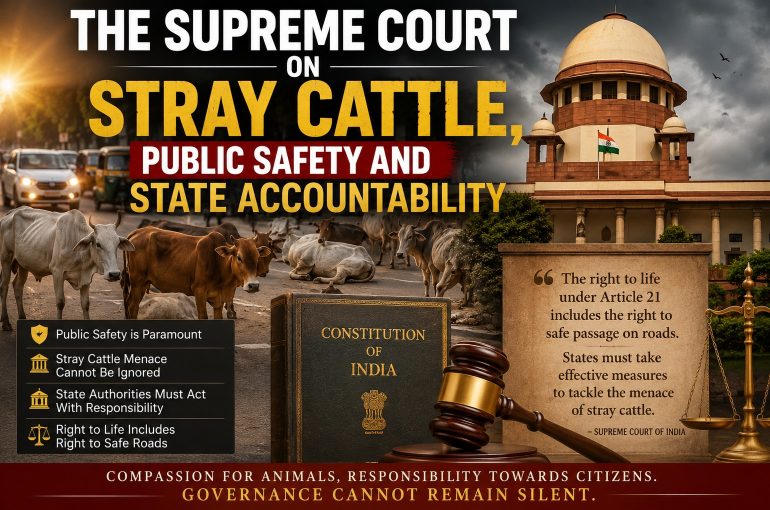
THE SUPREME COURT ON STRAY CATTLE, PUBLIC SAFETY AND STATE ACCOUNTABILITY

INTRODUCTION
In Nisha v. Municipal Council Sangrur & Ors. (decided on 31 July 2026), the Supreme Court of India, speaking through Justices Sanjay Karol and Nongmeikapam Kotiswar Singh, not only granted compensation to the Widow of the Deceased but also examined the larger constitutional and administrative failure in controlling stray cattle. The decision is significant because it moves beyond the individual dispute and provides policy recommendations aimed at preventing similar tragedies in the future. The Judgment highlights the constitutional responsibility of the State, the welfare of animals and the need to balance these obligations with the protection of human life.
BRIEF FACTS
The Deceased, Vijay Kumar, suffered a fatal head injury after being attacked by a stray bull while walking on a public road on 21 September 2007. The incident was duly reported to the police through a Daily Diary Report (DDR). During his lifetime, he sought compensation from the authorities, but his request was rejected. After his death, his Widow, Nisha, approached the Punjab and Haryana High Court through a Writ Petition seeking compensation.
The learned Single Judge awarded compensation of ₹29,32,000 along with 6% interest by applying the principles governing the grant of compensation under the Motor Vehicles Act,1988, taking into account of the Deceased, the age of the Claimants and other relevant factors. However, the Division Bench reversed this decision solely on the ground that the case involved disputed questions of fact and that a Writ Petition under Article 226 was not maintainable, leaving the claimant to pursue a civil suit.
Aggrieved by this decision, the Widow approached the Supreme Court.
ISSUES OF LAW
- Whether the High Court was justified in dismissing the Writ Petition on the ground that disputed questions of fact were involved.
- Whether compensation could be awarded in writ jurisdiction despite the availability of a civil remedy.
- Whether public authorities bear responsibility for injuries and deaths caused by stray cattle roaming on public roads.
- Whether principles analogous to the Motor Vehicles Act,1988 can be applied for determining compensation in such cases.
- Whether the Court should issue broader directions to address the recurring problem of stray cattle accidents.
ANALYSIS OF THE JUDGMENT
The Supreme Court adopted a balanced and practical approach while deciding the case. Rather than allowing procedural technicalities to overshadow the real issue, the Court focused on ensuring that justice was delivered to the Claimant and her family. It observed that the Claimant had been pursuing her compensation for nearly two decades. Requiring her to initiate fresh proceedings before a civil court after such a prolonged period would have been both unfair and unjust. Therefore, the Court held that the High Court ought to have decided the matter on its merits instead of dismissing the Writ Petition on technical grounds.
The Court also found that there was no real dispute regarding the facts of the case. The Municipal Council had never denied that the accident had taken place. Its only defence was that it lacked the financial resources to pay compensation. Since the occurrence of the accident itself was undisputed, the Court concluded that the Writ Petition was maintainable and could be decided without relegating the claimant to a civil suit.
Another significant aspect of the Judgment is the Court’s attempt to strike a balance between animal welfare and public safety. Referring to Articles 48(Organisation of Agriculture and Animal Husbandry) and 51A(g)(Fundamental Duty to Protect the Natural Enviornment and Living Creatures) of the Constitution, the Court acknowledged the constitutional duty of both the State and citizens to protect animals. At the same time, it emphasised that this responsibility cannot come at the cost of human life. Stray cattle roaming freely on public roads pose a serious threat not only to motorists and pedestrians but also to the animals themselves, making effective regulation essential.
The Judgment is noteworthy because it goes beyond resolving the individual dispute and addresses the larger issue of stray cattle management in India. The Apex Court stressed that merely having laws for cattle welfare is not enough. These laws must be implemented effectively. It recommended better animal shelters, proper identification and tagging of cattle, accountability of owners who abandon their animals and stronger coordination among local authorities to reduce such incidents in the future.
Finally, considering the prolonged litigation and the hardship suffered by the Appellant, the Supreme Court awarded a lump-sum compensation of Rs.15 lakh. However, it clarified that the amount was awarded in the peculiar facts and circumstances of the case and should not be treated as a standard measure of compensation for all future cases.
CONCLUSION
The Judgment in Nisha v. Municipal Council Sangrur & Ors. represents a progressive approach to public law litigation. Rather than limiting itself to awarding compensation, the Supreme Court addressed the broader governance issues responsible for recurring stray cattle accidents. The Court acknowledged that compassion for animals must coexist with effective public administration and the protection of human life.
TRISHMA KASHYAP
Legal Associate
The Indian Lawyer & Allied Service
Editor’s Comments
By restoring justice to the Claimant while simultaneously urging governments to establish better regulatory mechanisms, the Supreme Court transformed an individual compensation claim into a catalyst for institutional reform. The Judgment serves as a reminder that constitutional governance requires not merely the enactment of welfare legislation but its meaningful implementation, ensuring safety, accountability and dignity for both human beings and animals alike.
Sushila Ram Varma
Advocate and Chief Consultant
The Indian Lawyer & Allied Services
Watch our Latest Video. Click on the link below

Leave a Reply