



















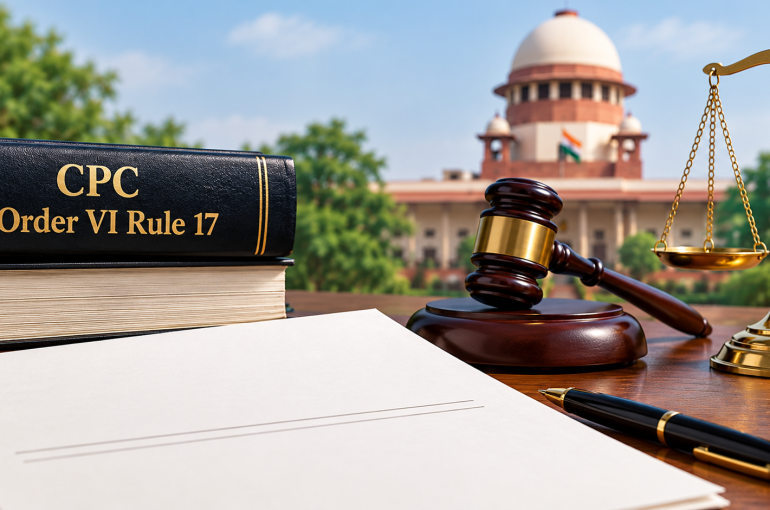
When a Plaint Can Be Amended After Trial Has Begun: Supreme Court on Order VI Rule 17 CPC

In Haramani Sahoo & Others v. Lalita Nayak & Others (2026 LiveLaw (SC) 1041), a Bench of Justice B.V. Nagarathna and Justice R. Mahadevan restated the principles governing amendment of a plaint after the commencement of trial. The Court set aside the Orders of the Trial Court and the Orissa High Court refusing the amendment. It allowed the amendment on payment of costs of Rs 25,000.
The Statutory position
Order VI Rule 17 of the Code of Civil Procedure, 1908 confers a discretionary power on the Court to permit either party to alter or amend pleadings at any stage, on such terms as are just. All amendments necessary to determine the real questions in controversy must be allowed. The proviso, inserted by the 2002 amendment, bars an application for amendment after the trial has commenced unless the court concludes that, in spite of due diligence, the party could not have raised the matter before the commencement of trial.
The Court described the object of the provision as enabling effective and complete adjudication of the dispute while preventing a party from introducing at a belated stage matters that could have been raised earlier with due diligence.
New case versus different approach
Relying on A.K. Gupta & Sons Ltd. v. Damodar Valley Corporation, the Court distinguished between an amendment that sets up a new case or cause of action and one that sets out a different or additional approach to the same facts. Citing Abdul Rahman v. Mohd. Ruldu, it reiterated that a change in the nature of relief claimed is not a change in the nature of the suit.
The Court also applied the factors from Ravajeetu Builders and Developers v. Narayanaswamy and Sons (2009) 10 SCC 84:
- whether the amendment is imperative for proper and effective adjudication
b. whether the application is bona fide or mala fide
c. whether it causes prejudice that cannot be compensated in money
d. whether refusal would lead to injustice or multiplicity of litigation
e. whether it fundamentally changes the nature and character of the case
Limitation
A claim clearly barred by limitation is a relevant factor, particularly where its introduction would defeat an accrued right of the opposite party. The position is different where limitation is itself arguable and depends on disputed facts, such as the date or manner in which the plaintiff acquired knowledge of the relevant document or transaction. The amendment need not be rejected at the threshold in that situation.
The Court referred to Sampat Kumar v. Ayyakannu, which holds that mere delay is not a ground for refusal. It also referred to Pankaja v. Yellappa, which holds that no absolute rule requires rejection of an amendment merely because the relief is alleged to be time-barred.
Scope of inquiry at the amendment stage
The inquiry at this stage is confined to the permissibility of the amendment. It does not extend to the ultimate merits or maintainability of the reliefs sought. Objections on those grounds cannot be finally adjudicated unless the proposed claim is ex facie barred in law. The opposite party remains free to raise them before the trial court.
Prejudice, multiplicity and costs
The Respondents argued prejudice from fresh pleadings. The Court held that fresh pleadings are not a ground to refuse an amendment. The prejudice arose mainly from the additional factual and legal issues the respondents would have to meet and this could be addressed by permitting an additional written statement and where necessary, imposing costs.
The Court also weighed the consequence of refusal. The controversy over the same property could be fragmented into separate proceedings, with the possibility of inconsistent findings on the same parcel of land. Against this, it placed the considerable delay and the inconvenience to the respondents. It allowed the amendment subject to costs of Rs 25,000, while preserving the respondents’ right to file additional pleadings and take all available objections.
Effect of the order
Allowing the amendment is not an acceptance of the averments incorporated in it. It confers no declaration or substantive right on the appellants. Maintainability, limitation and merits remain open for decision by the trial court in accordance with law.
Position emerging from the judgment
The proviso to Order VI Rule 17 operates as a threshold requirement once trial has commenced and the burden of showing due diligence lies on the applicant. Delay alone does not defeat the application and a plea of subsequent discovery is treated differently from a plea of oversight. Amendments that vary the approach to the same facts are viewed more favourably than those introducing a wholly new cause of action. Arguable limitation questions are left to the trial court. Prejudice compensable by an additional written statement and costs does not justify refusal, and avoidance of multiple proceedings on the same subject matter weighs in favour of allowing the amendment.
SHOMDEEPTA CHANDA
Associate
The Indian Lawyer & Allied Services
EDITOR’S COMMENTS
The general law is that, once a trial commences, any amendment in the pleadings will not be allowed. The reasoning is that if a matter has reached the stage of trial, it would cause great injustice to the affected party for reasons of delay as well as introduction of a new fact(s) which would necessarily mean that the affected party has to amend his/her pleadings. However, delay is not the only reason why such an application can be rejected. What is required of the applicant is to show that despite due diligence, they were not able to procure the document or the said material on which they are relying was not within their knowledge. Hence, only if the applicant can show bona fides, will amendment at the stage of trial be allowed. This relief is completely discretionary and depends on the manner in which the judge perceives the request for amendment. It is therefore advisable that any person filing a suit should take all steps to ensure that he/she gets the relevant information that is required. If the said information or evidence is not available the applicant can always move an application for discovery of the said information for evidence. Original matters must always be complete with all the supporting documents.
SUSHILA RAM VARMA
Chiel Legal Consultant
The Indian Lawyer & Allied Services
Please log onto our YouTube channel, The Indian Lawyer Legal Tips, to learn about various aspects of the law. Our latest Video, titled ” The Indian Market, Simplified | Integrated Legal, Financial & Business Solutions | The Indian Lawyer” can be viewed at the link below:
https://www.youtube.com/watch?v=GRvn5KqZK4w

Leave a Reply