



















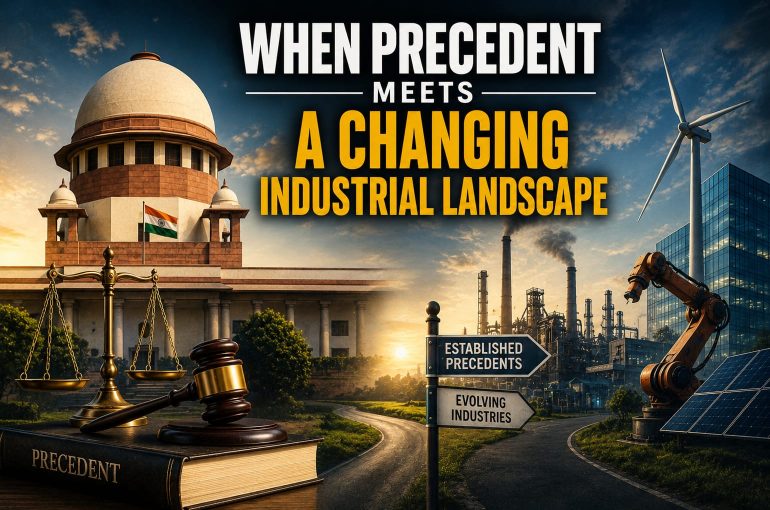
WHEN PRECEDENT MEETS A CHANGING INDUSTRIAL LANDSCAPE

INTRODUCTION
In State of Uttar Pradesh v. Jai Bir Singh (decided on 20 August 2026), the Supreme Court of India, speaking through Chief Justice of India Surya Kant, Justice Satish Chandra Sharma, Justice Alok Aradhe, Justice Vipul M. Pancholi, Justice P.S. Naraismha, Justice B.V. Nagarathna, Justice Dipankar Datta, Justice Ujjal Bhuyan and Justice Joymalya Bagchi, the Judgment ended a controversy that had continued for nearly five decades. At its heart was the celebrated decision in Bangalore Water Supply & Sewerage Board v. A. Rajappa (1978) 2 SCC 213, which had developed the “Triple Test” for determining whether an activity constituted an “industry”. The Nine Judges Bench ultimately held that the law declared in Bangalore Water Supply continues to govern disputes arising under the repealed Industrial Disputes Act, while the Industrial Relations Code, 2020 must be interpreted independently.
BRIEF FACTS
The dispute originated in the context of the Social Forestry Department of the State of Uttar Pradesh, a welfare oriented governmental activity. The question arose whether such a department could be treated as an “industry” under Section 2(j)[1] of the Industrial Disputes Act, 1947.
Earlier decisions had created uncertainty. In Chief Conservator of Forests v. Jagannath Maruti Kondhare, the Court had treated Social Forestry as falling within the definition of “industry”. Subsequently, State of Gujarat v. Pratamsingh Narsinh Parmar adopted a different approach on its facts. This apparent disagreement eventually led to the reference in Jai Bir Singh.
The Five-Judges Bench in Jai Bir Singh later raised broader doubts about Bangalore Water Supply, including its expansive interpretation of “industry”, the treatment of welfare activities and sovereign functions and the practical consequences of applying the Triple Test.
The matter ultimately reached the Nine-Judges Bench of the Supreme Court.
ISSUES OF LAW
[1] “industry” means any business, trade, undertaking, manufacture or calling of employers and includes any calling, service, employment, handicraft, or industrial occupation or avocation of workmen
1.Whether the Triple Test formulated in Bangalore Water Supply correctly interpreted “industry” under Section 2(j) of the Industrial Disputes Act?
2.Whether government welfare activities could fall within the definition of industry?
3.Whether reconsideration of Bangalore Water Supply was justified after decades of judicial reliance?
4.What effect the Industrial Relations Code, 2020 would have on the old jurisprudence?
ANALYSIS OF THE JUDGMENT
The Triple Test
In Bangalore Water Supply, Krishna Iyer, J. had formulated the well-known Triple Test. The Test requires the existence of: (i) a systematic and organized activity; (ii) cooperation between employer and employee in the conduct of such activity; and (iii) the production or distribution of goods and services directed towards the satisfaction of human wants and wishes. The Court had also clarified that profit motive was not essential. The nature of the activity, rather than merely its ownership or financial objective, was considered important.
This broad interpretation brought several institutions and activities within the possible reach of industrial law, including hospitals, educational institutions, government departments, charitable organizations and other service-oriented bodies.
The Importance of Stare Decisis
A major part of the Judgment concerned stare decisis or the principle that settled judicial decisions should not be disturbed without compelling reasons. The Court noted that Bangalore Water Supply had been followed for decades and had shaped the rights and expectations of employers and workmen. The majority opinion led by the CJI observed that mere disagreement with an earlier Judgment or dissatisfaction with its policy consequences, was insufficient to unsettle established precedent.
Justice Nagarathna went even further, holding that reconsideration of Bangalore Water Supply was unnecessary and that the reference itself served no meaningful purpose after the repeal of the Industrial Disputes Act.
Disagreement on the Triple Test
The Nine Judges Bench was not completely unanimous on the precise formulation of the Triple Test. Surya Kant, CJI, along with Satish Chandra Sharma, Alok Aradhe and Vipul M. Pancholi, JJ., considered that the Triple Test required a degree of reformulation and contextual application.
However, Justice Nagarathna, Justice Datta and Justice Bagchi maintained that the original Triple Test correctly interpreted Section 2(j). Justice Bagchi expressly stated that he agreed with Justices Nagarathna and Datta that the Triple Test remained the correct test under the Industrial Disputes Act. Thus, while there were differences in reasoning, the Judgment produced an important practical consensus.
Old Act and New Code
The Court clearly separated the old statutory regime from the new one. The Industrial Disputes Act has been repealed and the Industrial Relations Code, 2020 now contains its own definition of “industry”. Consequently, Bangalore Water Supply cannot simply be transplanted into the new Code.
The Court held that pending disputes under the old Act must continue to be decided according to the law applicable before the new Code became operational. At the same time, the new statutory definition must be interpreted independently. Justice Bagchi similarly emphasized that Bangalore Water Supply would remain confined to disputes under the repealed legislation and that the new Code must receive an independent interpretation.
Ratio Decidendi of the Judges
The core ratio emerging from the Judgment is that Bangalore Water Supply does not require reconsideration for disputes governed by the repealed Industrial Disputes Act. Its interpretation of Section 2(j) continues to govern pending matters under that legislation.
The majority also clarified that the new Industrial Relations Code, 2020 must not be interpreted mechanically through the old precedent. Justice Nagarathna held that Bangalore Water Supply was correctly decided and should not be disturbed. Justice Datta similarly supported preserving the settled position. Justice Bagchi expressly agreed that the original Triple Test correctly determined the scope of “industry” under the old Act.
The CJI led opinion, while favouring a standardized formulation, ultimately agreed that pending proceedings under the old Act should continue according to the established law.
CONCLUSION
The Supreme Court refused to disturb a precedent that had governed Indian industrial law for almost half a century. At the same time, it recognized that the legislative landscape has changed and that the Industrial Relations Code, 2020 must develop its own jurisprudence.
The Judgment therefore does not simply preserve Bangalore Water Supply. It places the decision in its proper historical and statutory context. For legacy disputes under the Industrial Disputes Act, the Triple Test remains relevant for future disputes under the Industrial Relations Code, the new statutory text must speak for itself.
In this sense, Jai Bir Singh closes an unusually long judicial journey not by erasing Bangalore Water Supply, but by ensuring that its legacy governs the law of the past without becoming an obstacle to the law of the future.
TRISHMA KASHYAP
LEGAL ASSOCIATE
THE INDIAN LAWYER & ALLIED SERVICES
Watch our latest video

Leave a Reply