



















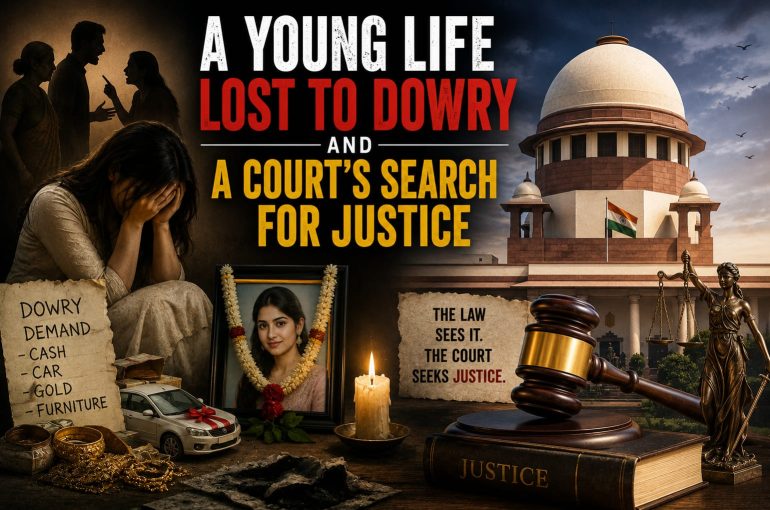
A YOUNG LIFE LOST TO DOWRY AND A COURT’S SEARCH FOR JUSTICE

INTRODUCTION
In State of Uttar Pradesh v. Ajmal Beg etc. (decided on 15 December 2025), the Supreme Court of India, speaking through Justices Sanjay Karol and Nongmeikapam Kotiswar Singh, the Appeals arose from the acquittal of Ajmal Beg and Jamila by the Allahabad High Court. The Supreme Court was called upon to examine whether the High Court was justified in discarding the Prosecution’s evidence relating to the repeated dowry demands, cruelty and the circumstances surrounding Nasrin’s death. The Judgment is significant not merely because it restored the convictions, but also because it emphasized that the law relating to dowry death must be applied with sensitivity to the social realities underlying such offences.
BRIEF FACTS
Nasrin was married to Ajmal Beg and had been living in her matrimonial home for just over a year when she died. According to the Prosecution, Ajmal, Jamila and other members of the family repeatedly demanded a colour television, a motorcycle and Rs.15,000 from Nasrin and her father. The demand was reiterated by Ajmal on 4 June 2001. The very next day, Nasrin was allegedly assaulted and threatened with death if the demands were not fulfilled. She called for help, but by the time people reached the spot, she had been set on fire after kerosene was poured over her. She could not be saved.
The Trial Court found Ajmal and Jamila guilty under Sections 304 B (Dowry death) and 498 A (Husband or relative of husband of a woman subjecting her to cruelty) of the Indian Penal Code, 1860 and Sections 3 (Penalty for giving or taking dowry) and 4 (Penalty for demanding dowry) of the Dowry Prohibition Act, 1961 and imposed sentences including life imprisonment for the offence of dowry death. The Allahabad High Court, however, acquitted them, mainly questioning the credibility of the Prosecution witnesses and finding it difficult to believe that a poor family could have demanded expensive articles.
Aggrieved by the acquittal, the State of Uttar Pradesh approached the Supreme Court. The Court examined whether the High Court had correctly appreciated the evidence and whether the ingredients of dowry death and cruelty had been established.
ISSUES OF LAW
1.Whether upon the prosecution establishing the necessary ingredients of Section 304 B IPC, the statutory presumption under Section 113 B of the Indian Evidence Act, 1872, arose against the Accused?
2.Whether the High Court was justified in discarding the testimony of the Prosecution witnesses on the basis of inconsistencies and the statement that the Deceased was living “happily” in her matrimonial home?
3.Whether the High Court was justified in relying upon the financial status of the Accused to doubt the existence of the alleged dowry demands?
4.Whether the High Court was justified in reversing the findings of the Trial Court and acquitting Accused despite the evidence establishing the dowry demands and their proximity to the death of the Deceased?
ANALYSIS OF THE JUDGMENT
The Supreme Court began by examining the legal requirements of dowry death. Section 304 B applies when a woman dies an unnatural death within seven years of her marriage. The law also looks at whether she was subjected to cruelty or harassment for a dowry demand shortly before her death. The Court explained that “soon before” does not mean immediately before; what is necessary is a reasonable connection between the dowry related cruelty and the death.
Applying this principle, the Court found that the evidence clearly established a continuing demand for the colour television, motorcycle and Rs.15,000. More importantly, the demand had been repeated just one day before Deceased’s death. This provided the necessary proximity between the harassment and the death. Once these circumstances were established, the presumption under Section 113 B (Presumption as to dowry death) of the Evidence Act, 1872 came into operation. The defense had not produced evidence sufficient to rebut that presumption.
The Court also rejected the High Court’s approach towards inconsistencies in the witnesses’ statements. It observed that minor inconsistencies do not automatically destroy the Prosecution’s case. Evidence must be examined as a whole, separating genuine inconsistencies from the central facts that remain consistent. In the present case, the repeated dowry demands and the harassment suffered by Deceased remained substantially consistent.
Particularly important was the Supreme Court’s assessment of the testimony of a witness namely, Khaliq Beg who had reached the scene shortly after the incident. Although he had not witnessed the actual moment when Deceased was set on fire, he had seen the Accused fleeing from the spot. The Supreme Court held that his evidence could not be completely discarded merely because he was not an eyewitness to the actual act, as his testimony remained relevant to the circumstances surrounding Deceased’s death.
The Court was equally critical of the High Court’s reasoning that Deceased’s family could not have been subjected to such demands because the Accused were poor. The Supreme Court rejected this reasoning as having no rational basis. It further clarified that the Dowry Prohibition Act does not restrict dowry demands only to those made before marriage. Demands made during or after marriage may also fall within the statutory definition when they are connected with the marriage.
The Supreme Court ultimately allowed the State’s Appeals and restored the Trial Court’s convictions of Ajmal and Jamila. However, considering Jamila’s advanced age of 94 years, the Court restored her conviction but refrained from sending her to prison on humanitarian grounds. Ajmal was directed to surrender and serve the sentence imposed by the Trial Court.
TRISHMA KASHYAP
LEGAL ASSOCIATE
THE INDIAN LAWYER & ALLIED SERVICES
Editors Comments
The Judgment sends a powerful message, a dowry death cannot be reduced to a dispute over inconsistent testimony or social assumptions about a family’s financial status. Courts must examine the evidence in its entirety and remain conscious of the social evil that the law seeks to prevent. State of U.P. v. Ajmal Beg therefore stands as a reminder that behind every demand for dowry may lie a pattern of coercion and cruelty and that the law must ensure that such cruelty does not disappear behind the walls of the matrimonial home.
SUSHILA RAM VARMA
LEGAL ASSOCIATE
THE INDIAN LAWYER & ALLIED SERVICES
Watch our latest video

Leave a Reply