



















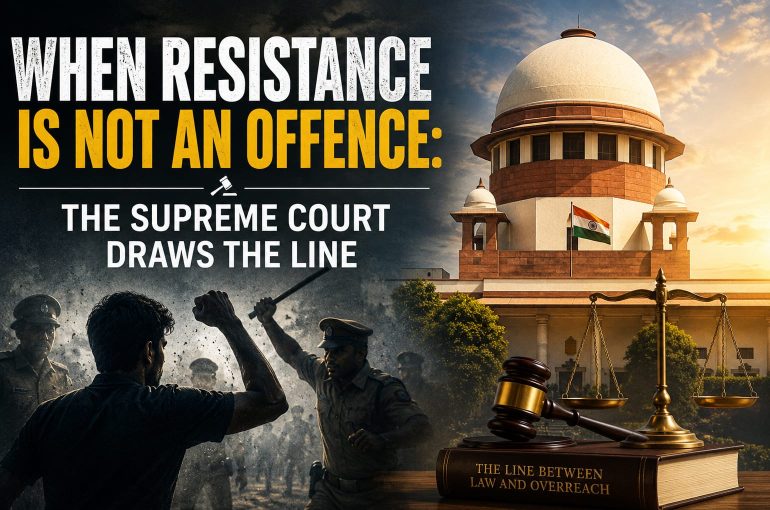
WHEN RESISTANCE IS NOT AN OFFENCE: THE SUPREME COURT DRAWS THE LINE

INTRODUCTION
In Ashwini Anantrao Deshpande v. State of Maharashtra ,SLP (Crl.) No. 8692/2026, the Supreme Court of India examined whether conduct allegedly amounting to resistance during a medical examination could attract criminal liability under provisions dealing with obstruction of public servants, threats to public servants and disorderly conduct. The Judgment was delivered on 12 August 2026 by a Bench comprising Hon’ble Mr. Justice K. V. Viswanathan and Hon’ble Mr. Justice Arun Palli. The Judgment arose from the Order dated 19 November 2025 passed by the Bombay High Court, Nagpur Bench.
The decision is significant because the Supreme Court once again demonstrated that criminal liability cannot rest merely upon an allegation of improper or unruly conduct. The facts alleged must satisfy the essential ingredients of the particular offence.
BRIEF FACTS
The Appellant, Ashwini Anantrao Deshpande, was a Lekhapal at the Forest Range Office, Paratwada. On 4 May 2021, the Forest Range Officer informed the police that she had allegedly been found in an intoxicated condition and was causing a disturbance. She was thereafter taken to the Sub-District Hospital, Achalpur, for medical examination.
The Prosecution alleged that, while at the hospital, Deshpande resisted the medical examination and created a scene. She was eventually persuaded to undergo the examination; her blood was collected and the medical process was completed. An FIR was thereafter registered under Sections 186 and 189 of the Indian Penal Code, 1860, along with Sections 110 and 117 of the Maharashtra Police Act, 1951.
The Appellant approached the Bombay High Court seeking quashing of the FIR and consequential proceedings. The High Court declined to exercise its jurisdiction under Section 528 of the Bharatiya Nagarik Suraksha Sanhita, 2023. She consequently approached the Supreme Court.
ISSUE OF LAW
The principal question before the Supreme Court was whether the allegations made against the Appellant disclosed the essential ingredients of the offences invoked against her.
More specifically, the Court considered whether resisting one’s own medical examination amounted to voluntarily obstructing a public servant under Section 186 IPC, whether the allegations constituted a threat contemplated by Section 189 IPC and whether the provisions of the Maharashtra Police Act relied upon by the Prosecution were attracted on the facts.
ANALYSIS OF THE JUDGMENT
The Supreme Court approached the matter by looking beyond the mere existence of an FIR and examining whether the alleged conduct actually satisfied the statutory requirements.
In relation to Section 186 IPC, the Court observed that the provision requires voluntary obstruction of a public servant in the discharge of a public function. On the Prosecution’s own case, the Appellant had resisted the medical examination but had ultimately undergone it. The Court held that such conduct could not, in the circumstances alleged, be brought within the expression “voluntarily obstructs any public servants in the discharge of his public function.”
The Court then considered Section 189 IPC. The provision contemplates a threat of injury to a public servant or a person in whom such public servant is interested, with the object of inducing the public servant to act, refrain from acting or delay an act connected with public functions. The Court found that the basic requirements of the provision were not present in the allegations.
The Court was equally unconvinced about the applicability of Sections 110, 112 and 117 of the Maharashtra Police Act. Section 110 deals, inter alia, with indecent language or disorderly behaviour in specified places, while Section 112 concerns threatening, abusive or insulting words or behaviour intended to provoke a breach of peace. Section 117 provides the penalty for contravention of the relevant provisions. The Supreme Court found that the Prosecution case did not disclose the necessary basis for invoking these provisions either.
The most important aspect of the Judgment is the Court’s insistence upon examining the allegations at their highest. Even assuming the Prosecution’s version to be correct, the Court found that the offences alleged were not made out. This distinction is crucial. Criminal law does not punish conduct simply because it may appear inappropriate or disorderly; the conduct must correspond to the legal ingredients prescribed by the statute.
Consequently, the Supreme Court allowed the Appeal, set aside the High Court’s Order and quashed both the FIR and the consequential charge sheet/final report proceedings.
CONCLUSION
The Judgment in Ashwini Anantrao Deshpande v. State of Maharashtra is a useful reminder of a basic safeguard embedded within criminal jurisprudence: an allegation is not synonymous with an offence.
Before criminal proceedings are permitted to continue, the allegations must disclose the ingredients of the offence invoked. The Supreme Court’s decision demonstrates that where the Prosecution case, even if accepted at face value, fails to cross that threshold, continuation of the criminal proceedings serves little legal purpose.
The Judgment therefore reinforces the importance of examining the substance of an allegation rather than merely its label. Criminal law must be applied with precision and the existence of an FIR cannot substitute for the existence of an offence.
SARTHAK KALRA
Senior Legal Associate
The Indian Lawyer & Allied Services
Watch our latest video

Leave a Reply