



















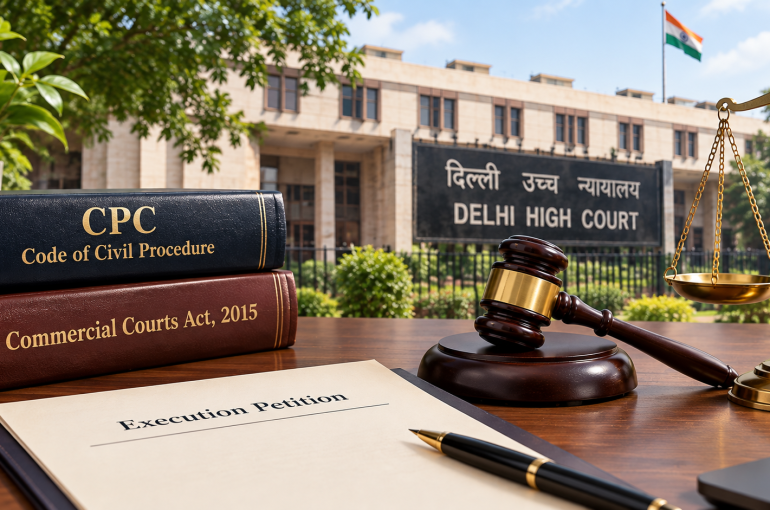
Delhi High Court Can Execute Commercial Decrees Below ₹2 Crore

Introduction
The Delhi High Court held in the case of Ozone Spa Pvt Ltd v. Co-Incept Hospitality Pvt Ltd & Ors., EX.P. 56/2022 that it may execute a decree whose amount falls below its pecuniary threshold of ₹2 crore, provided the suit that produced the decree was valued above that threshold. Justice Subramonium Prasad delivered the ruling in execution proceedings, establishing that a reduction in the decretal amount through settlement does not strip the court that passed the decree of its power to execute it.
Factual Background
The dispute arose from a franchise agreement dated 28 December 2013 (Agreement). Under the Agreement, the Judgment Debtors were permitted to operate a gym, spa and salon under the Ozone brand. Disputes followed and Ozone Spa instituted a commercial suit in 2018 seeking recovery of ₹2,53,66,750.
The Parties entered into a settlement agreement on 5 July 2018. The Court passed a decree on 19 July 2018 for ₹1,19,43,000, which is well below the ₹2 crore threshold. Ozone Spa later initiated execution proceedings, alleging that the Judgment Debtors breached the terms of the settlement. The Judgment Debtors raised a preliminary objection to the maintainability of the Execution Petition. The objection rested on the value of the decree and on the contention that the Commercial Courts Act, 2015 displaced the relevant provisions of the Code of Civil Procedure.
Issue
The issue before the Court was whether the High Court retains jurisdiction to execute a commercial decree of less than ₹2 crore when the underlying suit was filed in the High Court at a value above ₹2 crore.
Statutory Framework
Section 37 of the Code of Civil Procedure defines the expression “Court which passed the decree”. The definition covers the court of first instance and extends to certain appellate situations. It also covers cases where the original court has ceased to exist or has lost jurisdiction to execute the decree under the statutory conditions.
Section 38 of the Code provides that a decree may be executed either by the court that passed it or by the court to which it is transferred for execution.
Section 16 of the Commercial Courts Act provides that the provisions of the Code of Civil Procedure, as amended by the Commercial Courts Act, apply to the trial of a commercial dispute of a specified value.
Reasoning of the Court
The Court began with the relationship between the two statutes. It held that Section 16 of the Commercial Courts Act makes the Code of Civil Procedure applicable to commercial suits. Sections 37 and 38 therefore apply to decrees passed under the Commercial Courts Act. The Court rejected the argument that the Commercial Courts Act displaced those provisions.
The Court then examined the meaning of “Court which passed the decree” under Section 37. It held that the expression assumes a decree passed by the court of first instance. A court of first instance is treated as non-existent for this purpose only when the claims decided in the decree stand extinguished in their entirety. A change in the territorial or pecuniary jurisdiction of the court does not produce that result. A court does not cease to exist because the monetary limits of its jurisdiction change and such a change does not by itself extinguish its authority to execute a decree it has passed.
Applying Section 38, the Court held that the decree is executable by the court that passed it. The High Court passed the decree in a suit valued at ₹2,53,66,750, which lay within its pecuniary jurisdiction at the time of institution. The later settlement reduced the decretal amount to ₹1,19,43,000. That reduction did not alter the forum that passed the decree.
The Court also stated the consequence for forum. The High Court has jurisdiction to entertain suits above ₹2 crore and only the High Court can execute a decree in a suit that was filed before it at a value above ₹2 crore, even where the decretal amount is below that figure.
Analysis
The ruling ties execution jurisdiction to the forum that passed the decree and not to the amount of the decree. The pecuniary threshold operates at the stage of institution. The value of the suit at that stage determines the court that entertains it. A settlement or a partial adjudication that lowers the decretal amount operates after the forum has been fixed and it does not reopen the question of forum.
The ruling also confirms that the Commercial Courts Act does not create a separate code for execution. The Act incorporates the Code of Civil Procedure for commercial disputes through Section 16. The general provisions on execution in Sections 37 and 38 continue to govern commercial decrees.
The decision closes a possible route for a judgment debtor to resist execution by pointing to a settlement figure below the threshold. It also avoids a result in which a decree passed by the High Court would have to be transferred to a subordinate commercial court only because the parties compromised for a lower sum.
Conclusion
The Delhi High Court held that the Execution Petition was maintainable. The original suit exceeded ₹2 crore and fell within the pecuniary jurisdiction of the High Court. The settlement decree of ₹1,19,43,000 was passed by the High Court and the High Court alone could execute it. The Court dismissed the challenge to maintainability. The holding rests on Sections 37 and 38 of the Code of Civil Procedure and on Section 16 of the Commercial Courts Act and it fixes execution jurisdiction by reference to the value of the suit at institution.
Shomdeepta Chanda
Associate
The Indian Lawyer & Allied Services
Editor’s Comments
Under the law, parties have a right to agree to an out-of-court settlement in pending litigations. In this case also, the parties had mutually agreed for a settlement which necessarily implies that they wanted to settle the dispute. It is rather surprising that after having mutually agreed, one of them decided to challenge the execution proceedings. The law says one cannot approbate and reprobate at the same time. The High Court understood that the party challenging it was doing so with mala fide intentions and therefore closed the matter by holding that it was the appropriate executing court.
Sushila Ram Varma
Chief Legal Consultant
The Indian Lawyer & Allied Services
Please log onto our YouTube channel, The Indian Lawyer Legal Tips, to learn about
various aspects of the law. Our latest Video, titled “
CJP protest | Supreme Court ka Bada Faisla” can be viewed at the
link below:

Leave a Reply