



















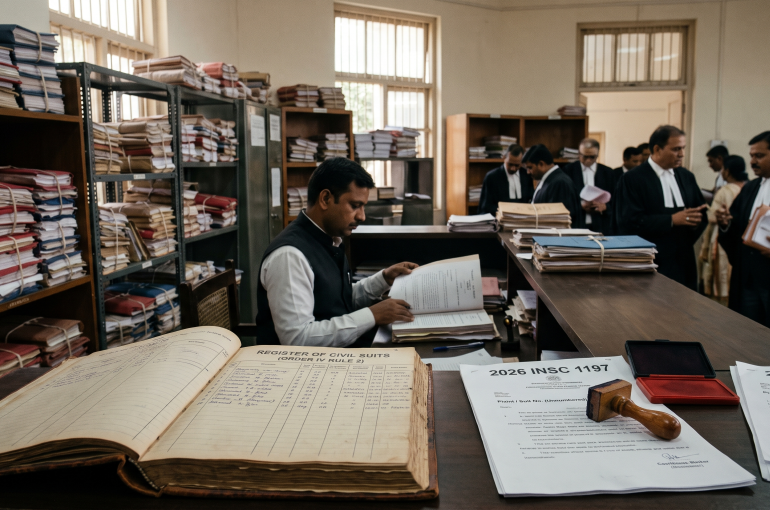
SUPREME COURT HOLDS THAT PLAINTS REJECTED AT PRE-REGISTRATION STAGE MUST BE RECORDED UNDER ORDER IV RULE 2

INTRODUCTION
The Hon’ble Supreme Court of India recently delivered a significant Judgment clarifying the procedural framework and threshold limits surrounding the rejection of plaints under Order VII Rule 11 of the Code of Civil Procedure, 1908 (“the Code”). In the case of G. Pazhanivel v. S. Thilagavathy (Civil Appeal No. 13154 of 2026, arising out of Unnumbered O.S. 19R Nos. 8886/2025 & 8973/2025; A.S. No. 970 of 2025), a Division Bench comprising Hon’ble Mr. Justice Ujjal Bhuyan and Hon’ble Mr. Justice Atul S. Chandurkar, on November 05, 2026, addressed whether a trial court possesses the jurisdiction to reject a plaint prior to its formal registration and numbering. It further considered whether the summary rejection of a suit seeking title declaration, redemption of mortgage and permanent injunction is sustainable when the plaint discloses a triable cause of action. The Apex Court held that while the judicial power to reject a plaint under Order VII Rule 11 of the Code can indeed be exercised at any stage of the proceedings, including prior to registration, courts cannot prematurely evaluate the likelihood of a suit’s ultimate success or conduct a deep, premature inquiry into the merits to reject a plaint that otherwise discloses a cause of action. Furthermore, to bridge serious administrative and procedural gaps, the Court issued mandatory directions stipulating that whenever a trial court rejects a plaint at the pre-registration stage, the fact of such rejection must be formally recorded in a register maintained under Order IV Rule 2[1] of the Code.
BRIEF FACTS
The dispute centered upon a piece of immovable land claimed to be owned by the Appellant-Plaintiff pursuant to a registered Settlement Deed dated 26th February, 2021, executed in his favor by his son. Needing financial assistance, the Plaintiff borrowed an amount of ₹25,00,000/- from the husband of the Respondent-Defendant at an interest rate of 24% per month (it appears that there is a typographical error in the judgment and the 24% per month ought to be read as 24% per annum). On the insistence of the Defendant’s husband, a registered Sale Deed of the suit property was executed on 15th March, 2021, in favor of the Defendant. The Plaintiff specifically asserted that the Sale Deed was executed merely by way of security for the loan transaction, while physical possession of the suit property continuously remained with the Plaintiff. When the Plaintiff subsequently offered to repay the principal loan amount of ₹25,00,000/- alongside accrued interest, the Defendant avoided executing a Sale Deed in the Plaintiff’s favor and attempted to take forcible possession of the suit property on 25th May, 2025.
On this cause of action, the Plaintiff presented an unnumbered Civil Suit before the learned Principal District Judge, Cuddalore, seeking a decree for declaration of title, permanent injunction protecting peaceful possession, redemption of the mortgage deed styled as a Sale Deed and mandatory injunction directing reconveyance of the property. Prior to registering or numbering the suit, the Principal District Judge heard the Plaintiff and perused the documents. Holding that the Sale Deed dated 15th March, 2021, did not contain any re-sale clause and that no separate re-sale agreement was filed, the Trial Court concluded that the Defendant enjoyed full rights over the property and summarily rejected the plaint. Aggrieved, the Plaintiff preferred an Appeal before a Division Bench of the High Court of Judicature at Madras. The High Court affirmed the rejection, holding that no inference of a conditional sale or mortgage could be drawn from the deeds and that the plaint lacked a cause of action. Aggrieved by the affirmation of threshold rejection, the Plaintiff preferred a Civil Appeal before the Supreme Court.
ISSUES OF LAW
The Supreme Court was called upon to resolve three primary legal questions:
- On the Maintainability of Order VII Rule 11 Rejection at Pre-Registration Stage: Whether a trial court has the power and jurisdiction under Order VII Rule 11 of the Code of Civil Procedure, 1908, to reject a plaint prior to its formal admission, numbering and entry into the Register of Civil Suits?
- On the Scope of Threshold Rejection Based on Merits and Cause of Action: Whether the trial court and the High Court erred in law by rejecting a plaint at the threshold after examining the merits of the documents and assuming the suit would fail, despite the plaint containing specific averments disclosing a triable cause of action for declaration, injunction and redemption?
- On Procedure and Record-Keeping for Pre-Registration Rejections: Whether plaints rejected prior to formal registration must be systematically recorded in a statutory register under Order IV Rule 2 of the Code to protect the legal rights of litigants and maintain a judicial record?
ANALYSIS OF THE JUDGMENT
The Supreme Court thoroughly evaluated the statutory framework of Order IV, Order V and Order VII of the Code, the binding judicial precedents on pre-registration powers and the essential distinction between the non-disclosure of a cause of action and the eventual prospect of dismissal after trial, arriving at several foundational conclusions:
(a) Jurisdictional Stage for Exercising Power under Order VII Rule 11: Reaffirming settled jurisprudence including T. Arivandandam v. T.V. Satyapal (1977 INSC 204), Saleem Bhai v. State of Maharashtra (2002 INSC 554), Madiraju Venkata Ramana Raju v. Peddireddigari Ramachandra Reddy (2018 INSC 249) and Church of Christ Charitable Trust v. Ponniamman Educational Trust (2012 INSC 264), the Bench emphasized that the power to reject a plaint can be exercised at any stage of the proceedings. This statutory authority commences right from the presentation of the plaint and extends through its pre-registration stage, after issuance of summons or at any point before the conclusion of trial. The Court observed that formal registration by itself does not bestow a shield of invincibility upon a plaint.
(b) Impermissibility of Assessing Prospects of Success at the Threshold: Evaluating the merits of the Lower Court Orders, the Apex Court held that both the Trial Court and the High Court committed a patent error. The Trial Court failed to read the plaint as a whole and misdirected itself by treating the Suit as a simpliciter redemption claim while ignoring explicit prayers for permanent injunction and reconveyance. The Bench reiterated that for the purposes of Order VII Rule 11(a), the averments in the plaint must be taken meaningfully as a whole. Relying on Ganga Bai v. Vijay Kumar (1974 INSC 87), the Court held that the likelihood of a Suit being ultimately dismissed after trial does not furnish a lawful ground to reject a plaint prior to trial if a cause of action is disclosed on the face of the pleadings.
(c) Mandatory Recording of Pre-Registration Rejections under Order IV Rule 2: Addressing the practical consequences of unnumbered plaints being rejected without an official footprint, the Apex Court highlighted that an order rejecting a plaint carries the force of a ‘decree’ under Section 2(2) of the Code. Allowing unregistered rejections to go unrecorded creates severe disadvantages during Appellate review when Trial Court records are summoned and deprives Defendants of crucial information regarding prior litigation under Order VII Rule 13 of the Code. Consequently, the Court directed that whenever a plaint is rejected prior to registration, the rejection must be formally recorded in a register maintained for such purpose under Order IV Rule 2 of the Code. High Courts were instructed to amend their Civil Manuals and applicable rules pursuant to Section 122 of the Code where such mechanisms are currently absent.
(d) Restoration of Plaint and Mandate for Full Trial: The Supreme Court set aside the Trial Court’s Order dated 11th July, 2025 and the High Court’s Judgment dated 16th October, 2025. The Apex Court restored the plaint, directing that it be duly registered and assigned a suit number for trial on merits in accordance with law, uninfluenced by any preliminary observations.
CONCLUSION
Holding that a plaint disclosing a cause of action cannot be summarily rejected at the threshold merely because the Plaintiff may face difficulty in succeeding at trial, the Supreme Court allowed the Appeal filed by G. Pazhanivel. The Apex Court restored the civil proceedings for formal registration and trial before the Principal District Judge, Cuddalore. By issuing mandatory administrative directions to all High Courts and Judicial Academies to ensure that pre-registration rejections are systematically entered into the statutory Register of Civil Suits under Order IV Rule 2, the Judgment establishes a vital procedural safeguard. This ruling ensures that judicial scrutiny at the institution stage remains strictly confined to statutory parameters without encroaching upon a litigant’s inherent right to a full trial.
ANIKET KUMAR PARCHA
Legal Associate
The Indian Lawyer & Allied Services
Please log onto our YouTube channel, The Indian Lawyer Legal Tips, to learn about various aspects of the law. Our latest Video, titled “Can a Finance Company Forcefully Recover Your Vehicle? Know Your Rights” can be viewed at the link below:
https://www.youtube.com/watch?v=w4RkuvlhyYU
[1] Order IV Rule 2. Register of suits.— The Court shall cause the particulars of every suit to be entered in a book to be kept for the purpose and called the register of civil suits. Such entries shall be numbered in every year according to the order in which the plaints are admitted

Leave a Reply