



















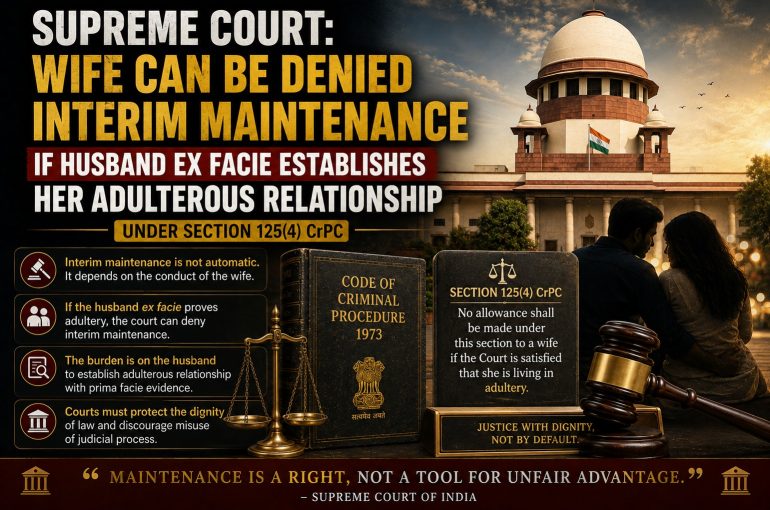
SUPREME COURT: WIFE CAN BE DENIED INTERIM MAINTENANCE IF HUSBAND EX FACIE ESTABLISHES HER ADULTEROUS RELATIONSHIP UNDER SECTION 125(4) CrPC

Himanshu Chordia v. State of Rajasthan and Anr. Criminal Appeal arising out of SLP (Crl.) No. 3171 of 2025 | 2026 INSC 778 Supreme Court of India | Coram: Sanjay Karol, J. (authoring) and Vipul M. Pancholi, J. | Decided on 31.07.2026
BRIEF FACTS OF THE CASE
The Appellant (Himanshu Chordia) and Respondent No. 2 married on 07.07.2014. Following matrimonial discord, the Wife left the matrimonial home in May 2020 with the child and her valuables and filed an Application under Section 125 CrPC for maintenance before the Special Additional Chief Judicial Magistrate, PCPNDT Cases, Udaipur. The usband filed an Application under Section 125(4) CrPC contending that the Wife was living in adultery and was therefore disentitled from any maintenance, placing photographs, videos and other material to substantiate the allegation. The Trial Court, by Order dated 27.06.2024, dismissed the Husband’s Section 125(4) Application, holding that the authenticity of the documents could only be determined after evidence was exhibited in the main petition and separately dismissed his Application under Section 91 CrPC. Interim maintenance of Rs. 25,000 each to the Wife and the child was subsequently granted. The Husband’s petition to quash these orders was dismissed by the High Court, which held that there was no provision requiring adjudication of the adultery issue as a preliminary matter before deciding interim maintenance and that the question was a disputed fact to be tried at final disposal. The Husband appealed to the Supreme Court.
ANALYSIS BY THE COURT
The Supreme Court allowed the appeal, set aside the High Court’s judgment and remanded the matter to the Trial Court.
The Court reiterated that proceedings under Section 125 CrPC are summary, civil in nature and beneficent, aimed at preventing vagrancy and destitution and are to be interpreted liberally in furtherance of that object. The Court held that Section 125(4) bars a Wife from receiving maintenance, whether interim or final, if she is living in adultery, refuses without sufficient reason to live with her Husband, or the parties are living separately by mutual consent. Since the provision expressly extends the bar to interim maintenance, the text itself indicates that the question of adultery cannot be deferred entirely to final adjudication.
The Court set out those proceedings under Section 125 in three stages: the Application for maintenance under Section 125(1), where interim maintenance may be granted under the second proviso; the Section 125(4) Application, which determines whether the matter proceeds to a final order; the final order under Section 125(1), with Section 125(5) applying to a situation arising after such a final order.
The Court held that pendency of a Section 125(4) Application does not automatically suspend interim maintenance, since that would make maintenance perpetually contingent on the adultery proceeding. Interim maintenance is to be stopped only where the Husband, at the first instance, establishes the allegation through evidence ex facie, on the face of the record, or where the fact is admitted. Where the evidence requires proof in accordance with law, interim maintenance continues while that evidence is examined.
Applying this standard, the Court held that the Trial Court and the High Court erred in treating the adultery issue as capable of determination only at final adjudication, since this would render the interim bar in Section 125(4) otiose. The Trial Court was directed to decide the Husband’s Section 125(4) Application on merits rather than deferring it.
The Court noted that the Husband’s evidence, comprising approximately 92 videos and 237 photographs, appeared to have been procured through private investigators and observed that this field remains unregulated in India, raising concerns of authorisation, data protection and the risk of morphed or doctored material. Referring to Navinchandra N. Majithia v. State of Meghalaya (2000) 8 SCC 323 : AIR 2000 SC 3275, R.M. Malkani v. State of Maharashtra (1973) 1 SCC 471 : AIR 1973 SC 157 and Arjun Panditrao Khotkar v. Kailash Kushanrao Gorantyal (2020) 7 SCC 1 on admissibility of electronic evidence under Section 65-B of the Evidence Act, the Court directed that a copy of the judgment be sent to the Secretary, Ministry of Law and Justice and the Chairman, Law Commission of India, for consideration of a regulatory framework for private investigation agencies, citing the pending Private Detective Agencies (Regulation) Bill, 2007 and comparable regulatory regimes in Queensland, Ontario, the Netherlands and Singapore.
CONCLUSION
The Appeal was allowed. The High Court’s judgment dated 04.02.2025 was set aside, and the matter was remanded to the Trial Court to decide the Husband’s Section 125(4) Application on merits.
Shomdeepta Chanda
Associate
The Indian Lawyer & Allied Services
EDITOR’S COMMENTS
The bar under Section 125(4) CrPC extends to interim maintenance and cannot be deferred wholesale to final adjudication. Interim maintenance is stopped only where the Husband establishes adultery ex facie or where it is admitted; otherwise, it continues pending proof. The Trial Court and High Court erred in postponing the Section 125(4) determination and the matter is remanded for decision on merits. The Court also flags the unregulated status of private investigation evidence in India and directs the Ministry of Law and Justice and Law Commission to consider a regulatory framework, citing the pending Private Detective Agencies (Regulation) Bill, 2007.
Sushila Ram Varma
Advocate and Chief Consultant
The Indian Lawyer & Allied Services
Watch our Latest Video. Click on the link below

Leave a Reply