



















THE HIGHEST BID IS NOT ALWAYS THE LAST WORD: PUBLIC INTEREST AND PRICE DISCOVERY IN E-AUCTIONS

INTRODUCTION
In Satinder Pal Singh & Ors. v. Bedi Hospital & Ors., 2026 INSC 1142, the Supreme Court of India, comprising Justice Pamidighantam Sri Narasimha and Justice Alok Aradhe, delivered its Judgment on 16 October 2026. The decision examines an important question in public auctions: does the highest bidder automatically acquire a right to the property or can the government reconsider the auction before the sale is formally completed?
BRIEF FACTS
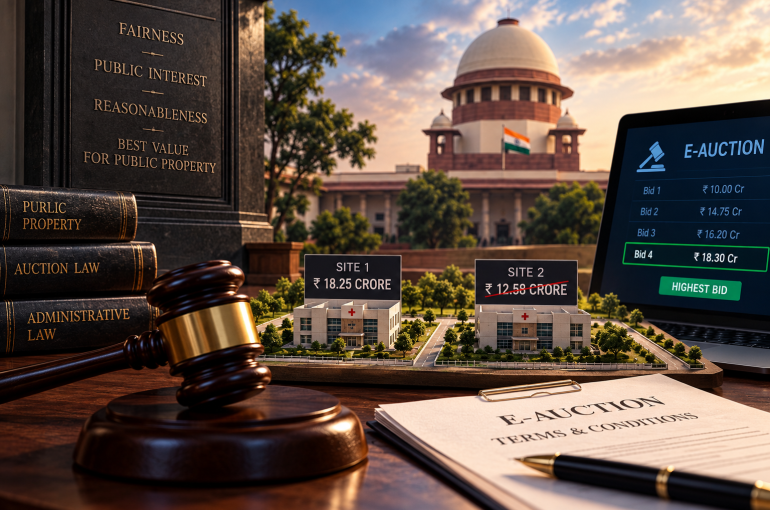
The dispute arose from an Auction conducted by the Chandigarh Administration for two nursing-home sites of the same size. While one site attracted a bid of approximately Rs. 18.25 crore, the other was sold at a substantially lower bid of Rs. 12.58 crore.
Bedi Hospital, the successful bidder for the second site, had paid the entire amount demanded under the auction process. However, before the formal allotment and transfer of the property were completed, the Administration cancelled the bid, citing the significant difference between the prices obtained for the two sites. The amount paid by the hospital was refunded.
Bedi Hospital challenged the cancellation before the Punjab and Haryana High Court, which ruled in its favour. In the meantime, a fresh auction had been conducted, in which the Appellant emerged as the successful bidder with an offer of Rs. 18.30 crore. The matter eventually reached the Supreme Court, which had to consider both the legality of the original cancellation and the consequences of the subsequent auction.
ISSUES OF LAW
The principal questions before the Supreme Court were whether a Public Authority could cancel a successful bid before the formal transfer of property, whether the decision was arbitrary merely because a higher price was expected and how the Court should deal with a subsequent auction conducted while the original dispute was pending.
ANALYSIS OF THE JUDGMENT
The Supreme Court began by examining the Chandigarh Estate Rules, 2007, and the conditions governing the Auction. These provisions allowed the Estate Officer to withdraw a property from auction or reject the highest bid. The Court emphasized the distinction between being declared the successful bidder and completing a legally enforceable contract.
In the present case, although Bedi Hospital had paid the entire bid amount and an Agreement to Sell had been executed, the allotment letter had not been issued and the conveyance deed had not been executed. The Court held that the contractual process had not reached the stage at which the Parties’ rights and obligations stood finally crystallised through the completed conveyance. Consequently, the Administration retained the power to reconsider the Auction under the applicable rules and conditions.
The Court’s reasoning, however, was not that the government could cancel an auction whenever it wished. Public authorities must act fairly, reasonably and without arbitrariness. Their decisions concerning public property must serve a legitimate public purpose rather than rest on mere preference or convenience.
An important consideration was the substantial difference between the amounts offered for two comparable sites. The Administration considered that accepting the lower bid would not adequately reflect the property’s market value. In the Supreme Court’s view, seeking a better price for public property was a legitimate objective, particularly when the formal transfer had not been completed. The cancellation was accompanied by an explanation of the reasons, a refund of the amount paid and an opportunity for Bedi Hospital to participate in the fresh auction.
The Court also distinguished earlier decisions relied upon in support of the Hospital’s case. It explained that those cases involved materially different circumstances, including arbitrary cancellation of completed lease arrangements or shortcomings in transparency and natural justice. Those principles remained important, but they did not establish that every successful bidder must necessarily receive the property regardless of the stage reached in the transaction or the circumstances surrounding the cancellation.
The subsequent Auction presented a further difficulty. It had been conducted while the Hospital’s Writ Petition was pending, following an interim arrangement made by the High Court. The High Court later set aside the original cancellation without adequately addressing the consequences of that subsequent Auction. The Supreme Court criticised this omission, observing that the litigation had created uncertainty for the parties involved.
The Appellant had offered Rs. 18.30 crore in the fresh Auction. Bedi Hospital subsequently expressed its willingness before the Supreme Court to match that amount, despite having chosen not to participate in the Auction. The Court nevertheless considered that simply allowing either party to retain the site would not satisfactorily resolve the complications that had arisen. It therefore directed the Administration to conduct another fresh e-auction, ensuring that the process followed the applicable rules.
SARTHAK KALRA
Senior Legal Associate
The Indian Lawyer & Allied Services
EDITOR’S COMMENTS
The Judgment reinforces the principle that the highest bid does not invariably confer an absolute right to allotment before the sale is formally completed. At the same time, it does not grant public authorities an unrestricted power to cancel auctions. Their decisions must remain fair, reasoned and consistent with the governing rules.
By directing a fresh auction, the Supreme Court sought to protect public interest while addressing the uncertainty created by the earlier proceedings. The decision is a reminder that public auctions must balance the legitimate expectations of bidders with the government’s responsibility to secure the best possible return from public property. The Appeals were allowed, the High Court’s Judgment was set aside and the Chandigarh Administration was directed to complete the fresh auction within three months.
SUSHILA RAM VARMA
Advocate & Chief Consultant
The Indian Lawyer & Allied Services
Please log onto our YouTube channel, The Indian Lawyer Legal Tips, to learn about various aspects of the law. Our latest Video, titled “CJP protest: Supreme Court ka Bada Faisla” can be viewed at the link below:
https://www.youtube.com/watch?v=TzB1rbG9_rs
Leave a Reply