



















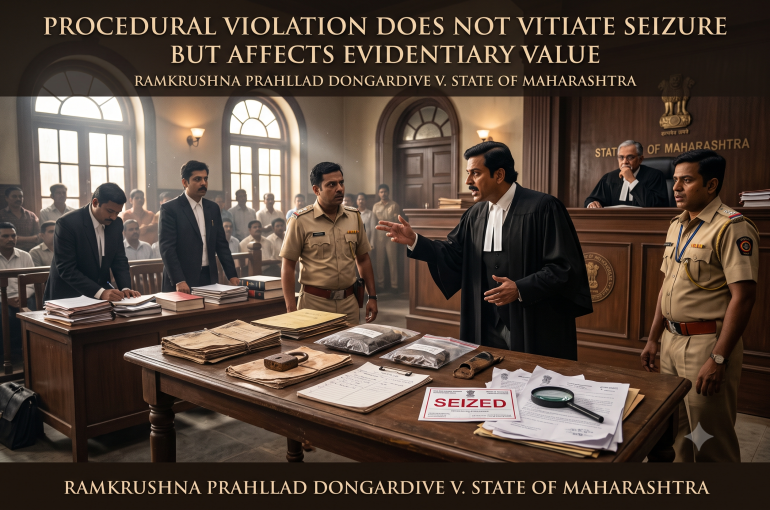
PROCEDURAL VIOLATION DOES NOT VITIATE SEIZURE BUT AFFECTS EVIDENTIARY VALUE: RAMKRUSHNA PRAHLLAD DONGARDIVE V. STATE OF MAHARASHTRA

The Supreme Court in the case of Ramkrushna Prahllad Dongardive v. The State of Maharashtra, Criminal Appeal No. 1432 of 2019 (2026 LiveLaw (SC) 1032) held that non-compliance with Section 100 of the Code of Criminal Procedure, 1973 does not by itself vitiate a seizure. The non-compliance is an irregularity in the investigation. It goes to the weight of the evidence supporting the search and recovery. Where the irregularity is accompanied by other infirmities in the prosecution case, it weighs in favour of the accused, particularly in an appeal against acquittal. The burden of proving a valid seizure rests on the prosecution.
Facts
The Appellant was a Cashier-cum-Counter Clerk in the Telephone Department at Aurangabad. The prosecution alleged that between 1 July 1993 and 9 October 1993 he collected telephone charges of ₹8,73,737. Of this, ₹3,88,035 was alleged to have been credited to the Government belatedly, which the Prosecution described as temporary criminal breach of trust. A further ₹4,75,702 was alleged never to have been credited. He was charged under Section 409 of the Indian Penal Code.
The Chief Judicial Magistrate, Aurangabad acquitted him on 20 February 2002. The trial court found the Prosecution evidence vague, found that the registers allegedly seized could not be exhibited and found that Section 100(7) of the Code had not been followed in the seizure of forty-six articles from his house. The Bombay High Court, Aurangabad Bench, reversed the acquittal in 2017 and sentenced him to one year of rigorous imprisonment and a fine of ₹5,000. The Appellant appealed to the Supreme Court.
The Seizure
The Prosecution relied on the seizure of forty-six documentary articles under a panchnama (Exhibit-86). Both panch witnesses turned hostile. One stated that his signature was obtained at the police station. The other stated that he was called while sitting with his auto-rickshaw outside the police station and that his signature was taken on some documents.
The investigating officer admitted that he did not obtain the Appellant’s signature on the panchnama. He admitted that he did not date his own signature. He admitted that the panchnama was not in his handwriting. He gave no explanation for the failure to furnish a list of the seized articles to the Appellant.
The High Court accepted the seizure on the testimony of the Investigating Officer alone. It held that the requirement of Section 100(7) was not mandatory and that the officer had no reason to depose falsely. The Supreme Court did not accept that reasoning. It found an infraction of Sections 100(4) and 100(7) of the Code. It held that, with both seizure witnesses not supporting the Prosecution, the seizure could not be treated as proved on the investigating officer’s deposition without corroboration.
The Legal Position on Section 100 Non-Compliance
The Court stated the position in two parts. First, non-compliance with Section 100 does not by itself vitiate a seizure and amounts to an irregularity in the investigation. Second, that irregularity is weighed with the other circumstances bearing on the prosecution case.
The Court relied on two earlier decisions. In Sunder Singh v. State of Uttar Pradesh (AIR 1956 SC 411), the defect in search witnesses was held to affect only the weight of the evidence supporting the search and recovery, and not the legality of the proceedings. In State of Punjab v. Balbir Singh (1994 INSC 96), the Court held that violation of Sections 100, 102, 103 or 165 of the Code does not per se vitiate the prosecution. The courts must examine whether prejudice was caused to the accused and must bear the violation in mind while appreciating the evidence.
The Court applied this position to the facts. The weight of the seized articles had to be assessed cumulatively with the other material on record.
Burden and Explanation of Possession
The High Court treated the Appellant’s failure to explain possession of the seized documents as an incriminating circumstance. The Supreme Court held that this was an error. The seizure had not been proved in accordance with law and the burden of proving a valid seizure lay on the Prosecution. An accused cannot be called upon to explain possession of articles whose seizure the prosecution has not established.
The Court cited Rabindra Kumar Dey v. State of Orissa (1976 INSC 204) for three principles. The onus lies on the prosecution to prove its case beyond reasonable doubt. The prosecution cannot derive benefit from weakness or falsity in the defence. The onus of the prosecution never shifts. An accused is required only to put forward an explanation that competes in probability with the prosecution version.
Other Findings
The seizure was one of several deficiencies in the Prosecution case.
The investigating officer admitted that the original cashbook, audit report and collection records were never produced by the complainant department. The Court held that these documents formed the basis of entrustment and that without them entrustment of cash to the Appellant was not established. The Appellant had repeatedly sought production of the daily cash handover register and the stock register of receipt books. The Department did not produce them. The Court upheld the trial court’s adverse inference against the Prosecution under Section 114(g) of the Evidence Act. It held that the High Court wrongly shifted the burden to the Appellant by observing that he should have produced the registers.
Exhibit-9 was an unsigned printed list that contained nothing connecting the Appellant to its figures. There was no record that the receipt books at Exhibit-8 were issued to him. Relying on R. Venkatakrishnan v. CBI (2009 INSC 1037), the Court restated that dishonest intention is an essential element of criminal breach of trust. Temporary misappropriation falls within the offence only where the ingredients are proved. The Court found no evidence of dishonest intention. The High Court failed to give due weight to the trial court’s assessment of the witnesses and to the presumption of innocence, as required by Chelloor Mankkal Narayan Ittiravi Nambudiri v. State of Travancore-Cochin (AIR 1953 SC 478).
Sentencing Hearing
The Court also noted that the High Court sentenced the Appellant without hearing him on sentence after reversing the acquittal. Relying on Mukesh Kumar Yadav v. State (UT of Andaman & Nicobar Islands) (2026 INSC 559), the Court stated that an appellate court convicting for the first time under Section 386(a) of the Code must hear the convict on sentence and impose the sentence itself. This observation did not affect the outcome, since the acquittal was restored.
The appeal was allowed. The Bombay High Court judgment dated 12 October 2017 was set aside. The acquittal recorded by the Chief Judicial Magistrate, Aurangabad on 20 February 2002 was restored. The bail bonds were cancelled.
Significance
The decision maintains the settled rule that a Section 100 violation is an irregularity and does not make a seizure void. It also records that the same violation, combined with hostile seizure witnesses, an unsupported police deposition and missing records, reduces the evidentiary value of the recovery. A court may not treat an accused’s silence on a seizure as incriminating when the prosecution has not first proved the seizure in accordance with law.
Shomdeepta Chanda
Associate
The Indian Lawyer & Allied Services
Editor’s Comments
The key takeaways from this judgment is that though the Supreme Court agreed the High Court decision reaffirming that a breach of Section 100 of the Code of Criminal Procedure is an irregularity in the investigation but that does not make a seizure void but it further explains that the irregularity does not stand alone. Where independent witnesses turn hostile, the investigating officer’s deposition is uncorroborated, and the departmental records on which entrustment depends are missing, the breach reduces the evidentiary value of the recovery and the benefit goes to the accused as in this case. This is something the IO of any case must be watchful of.
SUSHILA RAM
Advocate and Chief Consultant
The Indian Lawyer & Allied Services
Please log onto our YouTube channel, The Indian Lawyer Legal Tips, to learn about various aspects of the law.

Leave a Reply