



















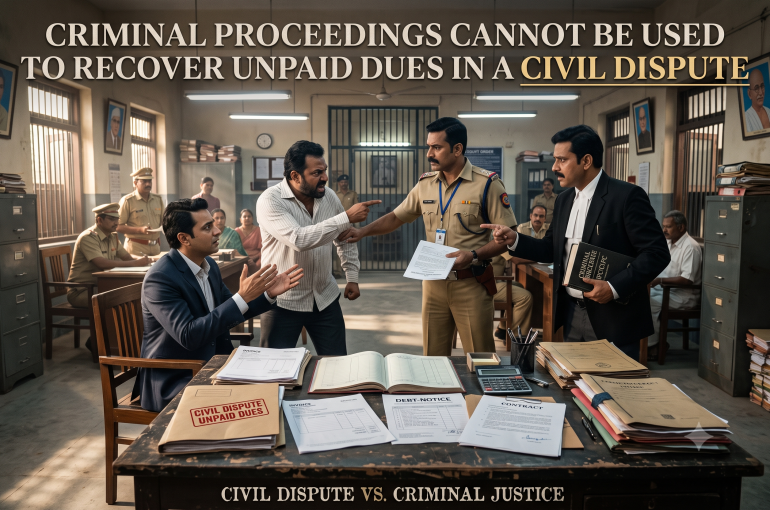
CRIMINAL PROCEEDINGS CANNOT BE USED TO RECOVER UNPAID DUES IN A CIVIL DISPUTE

The Supreme Court in the case of Yogesh Premjibhai Suvariya & Anr. v. State of Gujarat & Anr Special Leave Petition (Criminal) No. 6908/2026 held that a grievance over unpaid dues arising from a commercial transaction is essentially civil in nature. A Complainant who has a civil remedy for recovery cannot use criminal proceedings to recover the money. Continuation of such proceedings is an abuse of the process of the Court. The Court quashed the criminal case for cheating against the two appellant directors.
Facts
The Appellants are directors of Shivamy Enterprises Pvt. Ltd., a company in the steel business. The Informant (Respondent No. 2) is an employee of Hans Ispat Ltd. Since 2006, Shivamy Enterprises had purchased steel bars from Hans Ispat Ltd. and sold them to third parties.
The Prosecution alleged that the Appellants purchased Thermo-Mechanically Treated (TMT) bars worth ₹1,19,00,000 and that Hans Ispat Ltd. raised bills for the supply. The Appellants issued post-dated cheques. The cheques were dishonoured and the bills remained unpaid. An FIR was registered and a chargesheet was filed.
Procedural History
The Magistrate rejected the Appellants’ discharge application. The Gujarat High Court dismissed their revision application in March 2021 as not maintainable. In 2024, the Supreme Court held that the revision was maintainable and directed the High Court to decide it on merits.
In 2026, the High Court partly allowed the revision. It discharged the Appellants of criminal breach of trust under Section 406 IPC. It directed the Magistrate to frame a modified charge for cheating under Section 420 read with Section 114 IPC. The Appellants challenged that direction by Special Leave Petition. The Supreme Court stayed the Trial in April 2026.
Submissions
Senior Advocate Nikhil Goel appeared for the Appellants. The Appellants contended that the dispute was entirely civil and that the Informant had resorted to the criminal process in place of a civil suit for recovery. They relied on the FIR and the Informant’s own statement. These showed that a deposit of ₹2,00,00,000 made by Shivamy Enterprises was lying with Hans Ispat Ltd. and had not been returned despite repeated requests. The Appellants withheld the payment of ₹1,19,00,000 to set off that deposit.
The State accepted that the dispute may have had its origin in a business transaction with a civil flavour. It submitted that the subsequent withholding of payments carried criminal overtones and that the police had found the case fit for trial. No one appeared for the Informant.
Reasoning of the Court
The Court examined Sections 405, 406, 415, 420 and 114 IPC. It relied on G. Saminathan v. State for the position that the essential element of Section 415 IPC is fraudulence, dishonesty or intentional inducement. Without these elements the offence of cheating is not made out.
The Court then examined the Informant’s statement under Section 161 CrPC (now Section 180 BNSS). The Informant stated that Hans Ispat Ltd. was earlier owned by the Barnala Group, that Electrotherm India Pvt. Ltd. acquired it in 2010 and that Hans Ispat Ltd. took over thereafter. He admitted that the ₹2,00,00,000 was paid by the Appellants when the Barnala Group owned the company. His position was that the amount was to be repaid by the Barnala Group and not by the present owners and that the Appellants should therefore pay the amount due to him.
The Court held on this material that the Appellants were insisting on repayment of their deposit and had adjusted the dues of Respondent No. 2 against it. It held that the dispute raised by Respondent No. 2 was pre-eminently civil. It noted that no civil suit had been instituted against the Appellants.
The Court recorded that cheating and criminal breach of trust are independent and distinct offences and cannot coexist in the same set of facts. It also recorded that the police have no power or authority to recover money or to act as a civil court for recovery.
Conclusion of the Court
The Court held that the grievance of Respondent No. 2 was essentially civil. It held that he had resorted to criminal proceedings to recover amounts said to have been withheld by the Appellants and that this cannot be the object of a criminal proceeding. It held that allowing the proceedings to continue would be an abuse of the process of the Court. The criminal proceedings against the directors were quashed.
Shomdeepta Chanda
Associate
The Indian Lawyer & Allied Services
Editor’s Comments
The decision applies the settled test for separating a civil wrong from a criminal offence. Cheating requires dishonest intention at the time the transaction is entered into. Dishonoured cheques, unpaid invoices and withheld payments do not supply that intention. A set-off claim based on a prior deposit points to a commercial dispute over mutual dues.
The decision also records that the absence of a pending civil suit by the Complainant is a relevant circumstance. The Court treated the Complainant’s failure to avail the civil remedy as part of the basis for finding an abuse of process.
The case shows the High Court’s partial discharge being displaced at the Supreme Court stage. The High Court retained the Section 420 read with Section 114 charge after discharging the Appellants under Section 406. The Supreme Court did not sustain that distinction on the facts. It treated the entire dispute as civil and quashed the proceedings in full.
Sushila Ram
Advocate and Chief Consultant
The Indian Lawyer & Allied Services
Please log onto our YouTube channel, The Indian Lawyer Legal Tips, to learn about various aspects of the law.

Leave a Reply