



















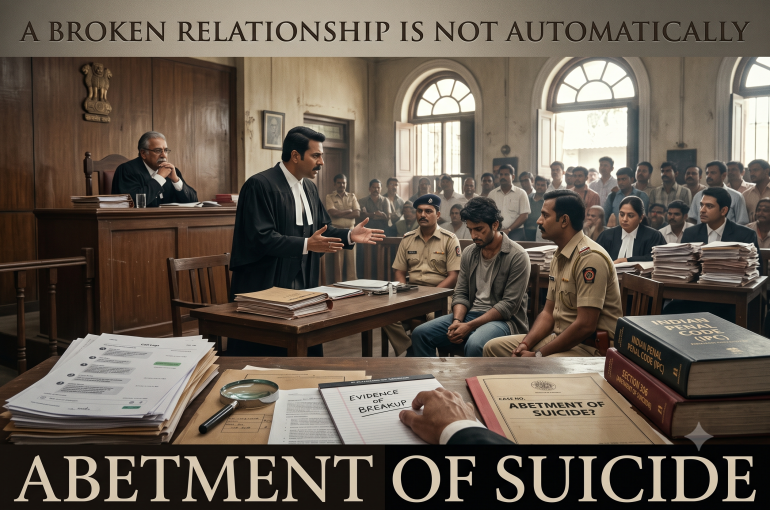
A BROKEN RELATIONSHIP IS NOT AUTOMATICALLY ABETMENT OF SUICIDE

INTRODUCTION
In Chittibarika Chandra Shekar & Others v. State of Telangana & Another, 2026 INSC 1100, the Supreme Court of India examined whether the refusal to marry a person, followed by that person’s suicide, was sufficient to prosecute the other person and his family for abetment of suicide under Section 306 read with Section 34 of the Indian Penal Code, 1860. The Judgment was delivered on 5 October 2026 by a Bench comprising Justice J.B. Pardiwala and Justice K. Vinod Chandran.
The case raises an important question: when a relationship ends and one person takes their own life, can the other person automatically be held criminally responsible? The Supreme Court held that a tragic outcome, by itself, does not establish the commission of a criminal offence.
BRIEF FACTS
The case arose from the death of a woman who had been in a relationship with the First Appellant, Chandra Shekar. According to the Complaint, the two were in a consensual relationship and had lived together at his house for about three months. The Complainant, who was the deceased woman’s sister, also stated that the relationship had been accepted by the First Appellant’s family.
The Sister alleged that the First Appellant later refused to marry the deceased. The Complaint further alleged that his friend spoke ill of the woman, while his Sister and Parents opposed the relationship. His Sister was also concerned that her own marriage prospects would be affected if the First Appellant married the deceased. According to the Prosecution’s account, these events contributed to the First Appellant withdrawing from the proposed marriage.
The woman subsequently died by suicide at the First Appellant’s house. Her siblings alleged that the conduct of the Appellants had driven her to take this step. Consequently, the six Accused faced proceedings under Section 306 read with Section 34 IPC for abetment of suicide.
The Accused approached the Supreme Court after the criminal proceedings continued against them. The Court examined the allegations in the Complaint and the circumstances described in the record.
ISSUES
The principal issue before the Supreme Court was whether the alleged refusal to marry, together with the conduct attributed to the other Accused, disclosed a case of abetment of suicide under Section 306 read with Section 34 IPC.
The Court also had to consider whether the criminal proceedings could continue when the allegations, even if accepted as stated by the Complainant, did not establish the necessary element of instigation.
ANALYSIS
The Supreme Court did not dispute that the woman’s death was by suicide. It also took note of the admitted relationship between the deceased and the First Appellant. The central question, however, was whether the Accused had instigated or abetted her suicide.
The Court examined the Complaint closely. It noted that the deceased had been in a consensual relationship with the First Appellant and that the relationship had been accepted by his family. The Court also questioned the circumstances in which the Complainant and her Sister had taken the deceased away from the First Appellant’s house. These facts formed part of the Court’s assessment of the allegations placed before it.
The Court then considered the allegation that the First Appellant’s refusal to marry had led to the suicide. It observed that people react differently when relationships end. A refusal to marry may cause emotional pain, but that does not mean that every such refusal amounts to abetment of suicide.
The important question was whether the conduct attributed to the Accused showed an intention to drive the deceased to take her own life. The Court found no such intention in the allegations before it. It also held that the Accused could not be presumed to have known that refusing the marriage proposal would lead the deceased to commit suicide.
The Court further considered the allegations against the other family members and the First Appellant’s friend. According to the Complaint, they had opposed the relationship or influenced the decision not to proceed with the marriage. However, even if the Complainant’s account was accepted in full, the Court did not find sufficient grounds to treat the alleged conduct as instigation to suicide.
This was the decisive point. The Court was not required to overlook the sadness of the circumstances. But criminal proceedings must rest on allegations that disclose the ingredients of an offence, rather than on the tragic result alone.
The Court therefore held that the prosecution could not be sustained on the allegations before it. It quashed the proceedings pending before the Competent Court in Telangana. It also directed that the Appellants be released if they were in custody and were not required in any other case.
CONCLUSION
The decision in Chittibarika Chandra Shekar & Others v. State of Telangana & Another underlines the distinction between a painful personal event and criminal abetment. The end of a relationship, even when followed by suicide, does not automatically make the other person criminally responsible.
SARTHAK KALRA
Senior Legal Associate
The Indian Lawyer & Allied Services
Editor’s Comments
The Judgment does not suggest that every case involving a relationship and suicide must be treated alike. The facts and allegations in each case must be examined carefully. What matters is whether the alleged conduct meets the legal requirements of the offence.
The broader lesson is that criminal law cannot impose liability merely because a person was involved in a relationship with someone who later died by suicide. There must be a sufficient basis to establish abetment. By quashing the proceedings in this case, the Supreme Court reaffirmed that criminal prosecution must rest on the ingredients of the alleged offence, not simply on the tragic circumstances in which a person died.
SUSHILA RAM
Advocate and Chief Consultant
The Indian Lawyer & Allied Services
Please log onto our YouTube channel, The Indian Lawyer Legal Tips, to learn about various aspects of the law.

Leave a Reply