



















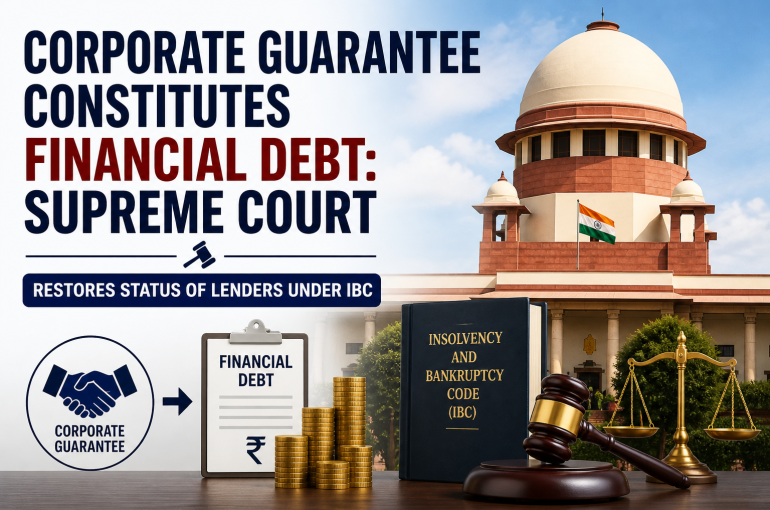
CORPORATE GUARANTEE CONSTITUTES FINANCIAL DEBT: SUPREME COURT RESTORES STATUS OF LENDERS UNDER IBC

INTRODUCTION
In State Bank of India & Ors. v. Doha Bank Q.P.S.C. & Anr., 2026 INSC 423, decided on 28 April 2026, the Supreme Court of India, comprising Justice Pamidighantam Sri Narasimha and Justice Alok Aradhe, examined the validity and enforceability of corporate guarantees within the framework of the Insolvency and Bankruptcy Code, 2016 (IBC). The Court held that liability arising from a corporate guarantee squarely falls within the definition of “financial debt” under Section 5(8) and that lenders are entitled to be recognised as financial creditors on that basis.
BRIEF FACTS
The case arose out of complex financing arrangements involving Reliance Group entities, where loans were extended by both domestic consortium lenders and foreign lenders. The Corporate Debtor executed corporate guarantees in favour of Consortium Lenders to secure loans granted to its Group Companies. Upon default and initiation of CIRP, the Consortium Lenders filed claims as financial creditors.
However, their claims were rejected by the NCLT on multiple grounds, including alleged lack of proper documentation, non-disclosure of guarantees in financial statements and doubts regarding verification and stamping of the guarantees. The NCLAT affirmed these findings, questioning the timing and manner of execution of the guarantees and treating them as unreliable. This led to the Appeal before the Supreme Court.
ISSUES OF LAW
The Supreme Court considered whether corporate guarantees constitute financial debt, whether rejection of claims on procedural and technical grounds was justified and whether the concurrent findings of the tribunals warranted interference.
ANALYSIS OF THE JUDGMENT
The Supreme Court began by reiterating the foundational requirement under the IBC that a financial debt must involve disbursal against consideration for the time value of money. It clarified that a corporate guarantee, by its very nature, creates a liability in respect of a loan that satisfies this requirement and therefore falls within the ambit of financial debt. The Court further emphasised that the liability of a guarantor is coextensive with that of the principal borrower, making such obligations legally enforceable.
A significant aspect of the Judgment is the Court’s finding that the execution of the corporate guarantees was not in dispute. It relied on documentary evidence, including communications from the Corporate Debtor’s own Counsel, which acknowledged the existence of the guarantees and confirmed that disclosures had been made in financial records. In light of this, the Court rejected the Tribunals’ doubts regarding the genuineness of the guarantees.
The Court also addressed the objection relating to the timing of execution of the guarantees. It held that although the borrower entities were under financial stress, the guarantees were executed as part of a restructuring exercise and prior to the subsequent classification of accounts as NPAs. Therefore, the timing could not be treated as suspicious or invalidating.
On the issue of non-disclosure in financial statements, the Court clarified that mere omission to reflect a guarantee in financial records cannot negate its legal existence or enforceability. At best, such omission may amount to a compliance lapse on the part of the Corporate Debtor, but cannot defeat the substantive rights of Creditors.
The Court further rejected the finding that the claims were improperly verified. It noted that the Resolution Professional had verified the guarantees by inspecting original documents in the custody of the Security Trustee. It held that the conclusion of the Tribunals regarding lack of verification was factually incorrect and therefore perverse.
Another important issue addressed was the alleged insufficiency of stamp duty. The Court held that the guarantees were executed in New Delhi and were duly stamped as per applicable law. Even otherwise, it reiterated the settled principle that insufficient stamping is a curable defect and does not render an instrument void or unenforceable. The Stamp Act, being a fiscal statute, cannot be used to defeat substantive rights.
The Court also clarified that relevant documents can be produced even at the appellate stage and failure to file them before the NCLT does not automatically invalidate the claim, particularly when their authenticity is not in doubt.
Ultimately, the Court found that the findings of the NCLT and NCLAT were not merely erroneous but perverse, warranting interference even within the limited appellate jurisdiction under Section 62 of the IBC.
CONCLUSION
The Supreme Court allowed the Appeal, set aside the Orders of the NCLT and NCLAT and held that the Appellants are financial creditors on the basis of corporate guarantees. It directed reconstitution of the Committee of Creditors to include the Appellants and continuation of CIRP in accordance with law.
This Judgment reinforces the principle that substantive commercial realities cannot be overridden by technical or procedural objections. By affirming the enforceability of corporate guarantees and clarifying their status under the IBC, the Court has strengthened creditor rights and ensured that insolvency proceedings are not derailed by hyper-technical challenges.
SARTHAK KALRA
Senior Legal Associate
The Indian Lawyer & Allied Services
Please log onto our YouTube channel, The Indian Lawyer Legal Tips, to learn about various aspects of the law. Our latest Video, titled “What to do when false FIR/case filed against you? How to deal with false cases” can be viewed at the link below:
https://www.youtube.com/watch?v=3-eTdcXE4M4

Leave a Reply