



















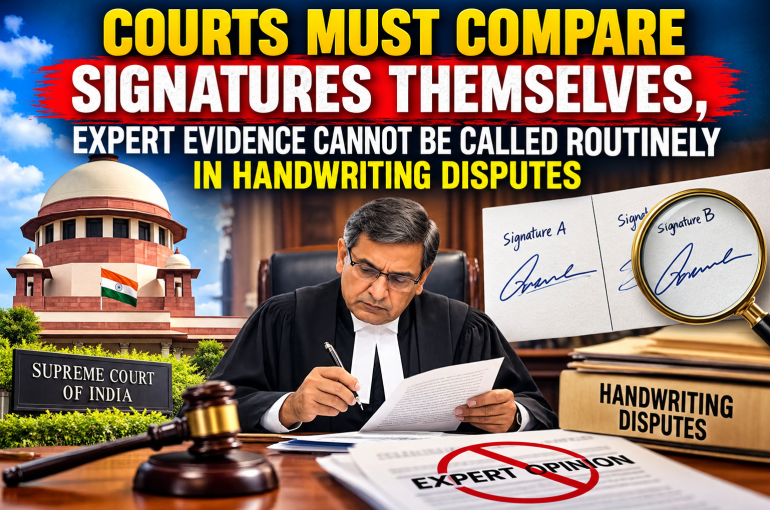
COURTS MUST COMPARE SIGNATURES THEMSELVES, EXPERT EVIDENCE CANNOT BE CALLED ROUTINELY IN HANDWRITING DISPUTES

INTRODUCTION
The Hon’ble Supreme Court of India recently delivered an important Judgment clarifying that trial courts are not legally required to send disputed signatures or handwritings to an expert as a matter of routine. In the case of Gopal Pathak v. Nitin Alias Pappu & Anr. (Civil Appeal No. 13004 of 2026), a Bench comprising Hon’ble Mr. Justice Ahsanuddin Amanullah and Hon’ble Mr. Justice Manmohan on September 18, 2026, allowed the Appeal of a landlord and set aside an order of the High Court of Madhya Pradesh. The Apex Court held that seeking an expert opinion under Section 39 of the Bharatiya Sakshya Adhiniyam, 2023 (BSA) is not mandatory or “essential” in every handwriting dispute. Instead, Section 72 of the BSA confers full discretion and a duty upon the court to compare signatures or handwritings directly and form its own independent conclusion.
BRIEF FACTS
The dispute originated from an eviction proceeding (RCSA No. 577A/2020) pending before the 12th Civil Judge, Junior Division, District Gwalior. The Appellant (landlord) initiated civil proceedings against the Respondents (tenants). During the Suit, the Respondents relied upon a disputed “Will” to resist eviction. Four years after the trial commenced in 2020 and following the completion of evidentiary testimony from both sides, the Respondents filed an application requesting the court to send the disputed Will to a handwriting expert for examination under Section 39 of the Bharatiya Sakshya Adhiniyam, 2023.
The Appellant resisted the prayer, pointing out that a Second Sale Deed dated October 20, 1981, expressly recorded that the father of the Respondents was a tenant, a document admitted by the Respondents in their application under Section 39 of the BSA. The Appellant contended that allowing an expert examination four years into the trial would unnecessarily re-open the entire evidentiary process.
On October 06, 2025, the Trial Court rejected the Respondents’ application, holding that it was fully competent to evaluate the signature itself. However, in M.P. No. 5813/2025, the High Court of Madhya Pradesh at Gwalior overturned the Trial Court’s ruling on October 27, 2025, holding that sending the Will to a handwriting expert was “essential” for determining its genuineness. Aggrieved by the High Court’s directive, the Appellant appealed to the Supreme Court.
ISSUES OF LAW
The Supreme Court was called upon to resolve key evidentiary and procedural questions under the Bharatiya Sakshya Adhiniyam, 2023:
-
Whether obtaining an expert opinion under Section 39 of the Bharatiya Sakshya Adhiniyam, 2023 is mandatory (“essential”) to determine the genuineness of a disputed Will or signature?
-
Whether the trial court retains the discretion and duty under Section 72 of the BSA, 2023 to compare disputed signatures/writings on its own, rather than referring them to an expert?
-
Whether the precedent in Thiruvengada Pillai v. Navaneethammal & Anr. (2008) 4 SCC 530 makes expert examination compulsory in all cases involving disputed handwritings or signatures?
ANALYSIS OF THE JUDGMENT
The Supreme Court thoroughly evaluated the statutory provisions of the Bharatiya Sakshya Adhiniyam, 2023 along with existing judicial precedents, arriving at foundational legal conclusions:
-
Discretion and Duty of the Court Under Section 72 BSA: The Court highlighted that Section 72 of the Bharatiya Sakshya Adhiniyam, 2023 explicitly empowers courts to compare disputed signatures, writings or seals with admitted or proved ones. The Bench observed that the law confers discretion upon the court to decide whether to make the comparison itself or seek expert assistance. Crucially, the Court held that it is the duty of the court to compare disputed writings and reach its own decision, which cannot be avoided by simply claiming that the court is not an expert.
-
Advisory Nature of Expert Evidence: The Bench noted that an expert opinion under Section 39 of the BSA is merely opinion evidence and is not binding on the court. Consequently, the High Court’s finding that obtaining expert evidence is “essential” for determining genuineness was held to be legally untenable.
-
Circumstances Permitting Expert Reference: While rejecting routine referrals, the Supreme Court clarified that courts retain full discretion to seek expert advice in exceptional scenarios, such as when genuine doubt arises or when the writing/impression is smudgy, vague, or light.
-
Distinction and Clarification of Precedent: The Respondents had relied upon Thiruvengada Pillai v. Navaneethammal & Anr. (2008) 4 SCC 530 to argue that judicial comparison of signatures is hazardous. The Apex Court clarified that Thiruvengada Pillai dealt specifically with a disputed finger impression rather than handwriting or signatures. Thus, observations in that precedent cannot be expanded to mean that examining an expert witness is mandatory in every handwriting or signature dispute.
-
Restoration of Trial Court Order & Expedition of Trial: Finding no flaw in the view taken by the Trial Court, the Supreme Court set aside the High Court’s Order and restored the Trial Court’s decision dated October 06, 2025. Furthermore, observing that the matter pertains to an eviction suit, the Bench directed that the proceedings be expedited and concluded swiftly in accordance with law.
CONCLUSION
Holding that expert testimony under Section 39 of the Bharatiya Sakshya Adhiniyam, 2023 is purely advisory and not mandatory, the Supreme Court allowed the Appeal and restored the Trial Court’s order.
ANIKET KUMAR PARCHA
Legal Associate
The Indian Lawyer & Allied Services
EDITOR’S COMMENT
This judgment serves as a pivotal precedent against the routine and dilatory practice of referring disputed documents to handwriting experts. By reaffirming the court’s primary duty under Section 72 of the BSA to examine signatures independently, the Apex Court reinforced that expert evidence is intended to assist, not substitute, judicial determination, thereby preventing undue delays in civil litigation.
Advocate & Chief Consultant
The Indian Lawyer & Allied Services
Please log onto our YouTube channel, The Indian Lawyer Legal Tips, to learn about various aspects of the law.

Leave a Reply