



















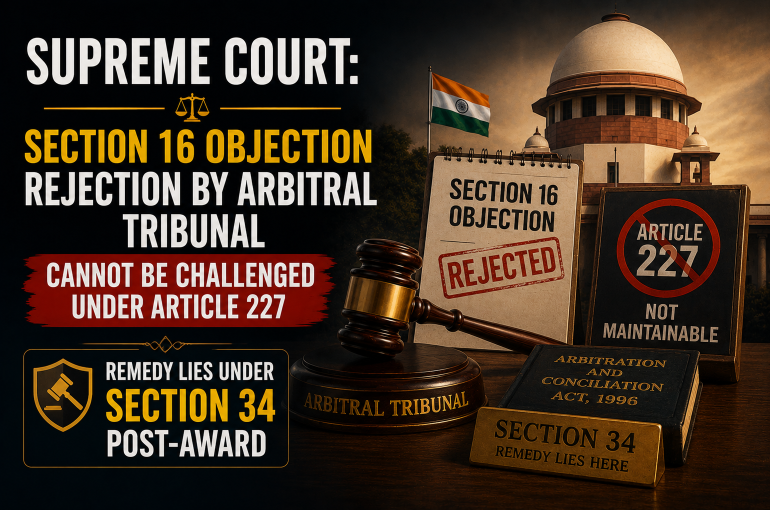
SUPREME COURT: ARBITRAL TRIBUNAL’S REJECTION OF SECTION 16 OBJECTION CANNOT BE CHALLENGED UNDER ARTICLE 227, REMEDY LIES UNDER SECTION 34 POST-AWARD

INTRODUCTION
In a significant ruling reinforcing the doctrine of minimal judicial interference in arbitration, the Supreme Court, in the case of Manash Kamal Bezboruah v. Bokahola Tea Company Private Limited, 2026 SCC OnLine SC 1330 has held that a High Court cannot entertain a revision petition under Article 227 of the Constitution against an Arbitral Tribunal’s Order rejecting a jurisdictional objection under Section 16 of the Arbitration and Conciliation Act, 1996. A Divisional Bench of Justices K.V. Vishwanathan and Vijay Bishnoi set aside the Impugned Order of the Guwahati High Court, holding that such interference is permissible only in the rarest of cases involving a “patent lack of inherent jurisdiction” apparent on the face of the record and even then, the proper remedy ordinarily lies under Section 34 after the final award.
BRIEF FACTS OF THE CASE
The dispute traces back to a decades-old family partnership in the tea business. The Appellant, Manash Kamal Bezboruah, instituted a Civil Suit in 2012 alleging mismanagement and financial irregularities, seeking rendition of accounts against the Partnership Firm and related Companies. An Application under Section 8 of the 1996 Act seeking reference to arbitration was rejected by both the Trial Court and the High Court, on the ground that several Defendants were non-signatories to the partnership deed containing the arbitration clause.
On further Appeal, the Supreme Court, with the consent of parties, referred the disputes to arbitration in November 2024 and appointed Justice (Retd.) B.P. Katakey as Sole Arbitrator. Notably, Respondent Nos. 1 to 3 (the non-signatory companies) were parties to that Appeal but chose not to contest it.
During arbitration, Respondent Nos. 1 to 3 filed Applications under Order VII Rule 11 read with Order I Rule 10(2) and Section 151 Code of Civil Procedure, 1908, seeking deletion of their names from the array of parties on the ground that they were non-signatories. The Tribunal treated these as objections under Section 16 of the Act and rejected them, holding that the Supreme Court’s Consent Order had already referred all parties to arbitration, leaving no scope to revisit the issue.
Aggrieved, Respondent Nos. 1 to 3 filed a Civil Revision Petition under Article 227 before the Guwahati High Court. The High Court stayed the notices issued to them and relying on Deep Industries Ltd. v. ONGC (2020) 15 SCC 706 and Punjab State Power Corporation Ltd. v. Emta Coal Ltd. (2020) 15 SCC 706, held the Revision Petition maintainable on the ground that the Tribunal’s order suffered from a “patent lack of Inherent jurisdiction.”
THE QUESTION BEFORE THE COURT
The sole issue was whether the High Court was justified in exercising its supervisory jurisdiction under Article 227 to entertain a challenge to the Tribunal’s Section 16 order and in staying the arbitral proceedings pending such challenge
THE COURT’S ANALYSIS
The Bench reiterated that the 1996 Act is a self-contained code designed to ensure expeditious resolution of disputes with minimal judicial interference, a policy reflected in the non-obstante clause of Section 5. While acknowledging that Article 227, being a constitutional provision, cannot be ousted by statute, the Court emphasised that it must be exercised with “extreme restraint” in arbitral matters, restricted to cases where the Tribunal’s Order is so perverse that a patent lack of inherent jurisdiction “stares one in the face”, a standard drawn from SBP & Co. v. Patel Engineering Ltd.(2005) 8 SCC 618 : (2005) 128 Comp Cas 465, Deep Industries and Punjab State Power Corporation.
Applying this standard, the Court found that the Guwahati High Court had not recorded any prima facie finding of the jurisdictional defect or perversity before entertaining the Revision Petition. Crucially, the Court held that the question of whether Respondent Nos. 1 to 3 were “veritable parties” to the Arbitration Agreement, despite being non-signatories, is precisely the kind of complex factual and legal inquiry that, per the Constitution Bench in Cox and Kings Ltd. v. SAP India Pvt. Ltd. (2024) 4 SCC 1 : (2024) 2 SCC (Civ) 1 : (2024) 251 Comp Cas 680, falls within the Arbitral Tribunal’s own competence under the doctrine of kompetenz-kompetenz embodied in Section 16.
The Bench also noted an important estoppel-type observation; Respondent Nos. 1 to 3 had been parties to the earlier Supreme Court Appeal that referred all disputes to arbitration but never contested it, sought review or sought modification. Allowing them to now resist arbitration through an Article 227 Petition, the Court observed, amounted to an avoidable and unnecessary second round of litigation that defeats the very object of the Act.
CONCLUSION
The Court set aside both the Interim Order and the Final Order passed by the Guwahati High Court and dismissed the Revision Petition. However, since the Tribunal had already framed the relevant issues concerning the non-signatory status of Respondent Nos. 1 to 3, the Court directed the Tribunal to Independently decide that question, uninfluenced by the Supreme Court’s observations and to complete the arbitration expeditiously.
The Judgement reaffirms a now well-settled line of authority, from SBP & Co. through Deep Industries and Punjab State Power Corporation to the recent Tarini Prasad Mohanty v. Sunflag Iron and Steel Company Ltd. 2026 INSC 566, that High Court must exercise extreme circumspection before entertaining Article 227 petitions against interlocutory arbitral orders and must record specific findings of perversity or patent jurisdictional defects doing so.
SHOMDEEPTA CHANDA
Legal Associate
The Indian Lawyer & Allied Services
Please log onto our YouTube channel, The Indian Lawyer Legal Tips, to learn about various aspects of the law. Our latest Video link is in below:

Leave a Reply