



















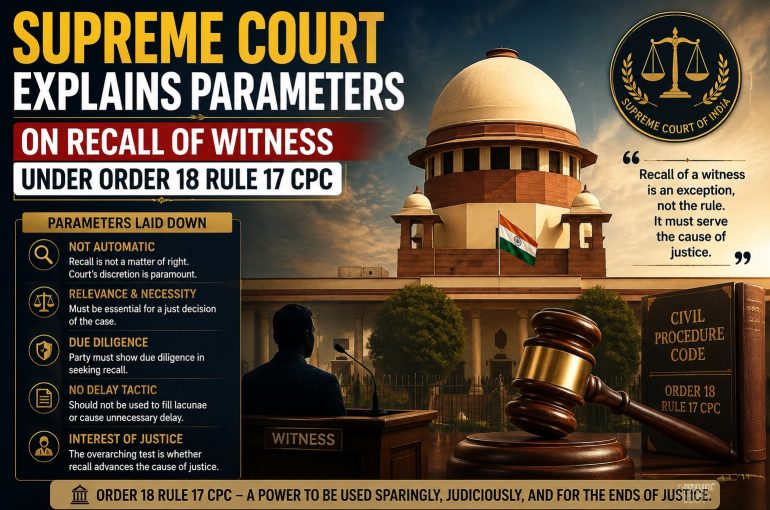
SUPREME COURT EXPLAINS PARAMETERS ON RECALL OF WITNESS UNDER ORDER 18 RULE 17 CPC

INTRODUCTION
The Hon’ble Supreme Court of India recently tackled a critical procedural question regarding the scope and limits of recalling a witness and reopening evidence at the fag end of a civil trial. In K. Bharathamma v. Bandaru Sakku Bai & Ors. (2026 INSC 795), decided on August 04, 2026, a two-judge Bench comprising Hon’ble Justices S.V.N. Bhatti and N.V. Anjaria delivered a definitive verdict. The Court made it clear that Order XVIII Rule 17 of the Code of Civil Procedure, 1908 (CPC) is not a handy tool for litigants to fill gaps in their evidence. The Apex Court firmly ruled that the power to recall a witness is a court-centric discretion to clarify ambiguities and applications for recall cannot be granted merely on the ground that doing so causes “no prejudice” to the opposing party.
BRIEF FACTS
The dispute originated from a 2010 Suit (O.S. No. 489 of 2010, renumbered as O.S. No. 1302 of 2022) before the Additional Senior Civil Judge, Medchal -Malkajgiri, where the Plaintiffs sought a declaration of ownership and cancellation of two registered sale deeds from 1987.
The trial had advanced to the stage of final arguments; both sides had concluded their evidence, witness examinations (PW-1 to PW-4) were complete and documentary exhibits (Ex. A1 to A35) were marked.
While final arguments were underway, the Plaintiffs filed three interim Applications: I.A. No. 716 of 2022 under Order XVIII Rule 17 CPC (to recall PW-1), I.A. No. 717 of 2022 under Section 151 CPC (to reopen evidence) and I.A. No. 718 of 2022 under Order VII Rule 14 CPC (to receive additional municipal documents regarding house numbers).
The Trial Court allowed all three interim Applications on December 08, 2022, primarily observing that “no prejudice would be caused” to the Defendants even though the trial was at its fag end.
In Civil Revision Petition Nos. 458, 496 and 621 of 2023, the High Court for the State of Telangana at Hyderabad modified the Orders by setting timelines to complete the recall, mark the documents and allow the Defendant to cross-examine PW-1.
Aggrieved by the High Court’s Order, Defendant No. 1 preferred Civil Appeals before the Supreme Court.
ISSUES OF LAW
The Apex Court focused its evaluation on three fundamental legal questions:
Can Order XVIII Rule 17 of the CPC be invoked by a party to fill omissions, lacunae or gaps in evidence already adduced once final arguments have commenced?
Does the absence of prejudice to the opposing party serve as a valid, standalone legal ground to allow an application under Order XVIII Rule 17 CPC?
Does Order XVIII Rule 17 CPC empower a court to recall a witness for the purpose of further cross-examination by the parties?
ANALYSIS OF THE JUDGMENT
The Supreme Court took a sharp, principled stance against the liberal and mechanical exercise of powers under Order XVIII Rule 17 CPC, laying down the following key parameters:
Order XVIII Rule 17 is Court-Centric, Not Party-Centric: The Bench highlighted that the primary scheme of Order XVIII Rule 17 CPC (read with Section 165 of the Evidence Act) is to enable the Court to put questions to a witness to clarify doubts that arose during examination. While a party may draw the court’s attention, the power remains strictly within the discretionary realm of the trial judge to facilitate adjudication, rather than serving as an automatic right for parties.
The Fallacy of the “No Prejudice” Test: The Apex Court rejected the Trial Court’s frontline reasoning that recalling a witness should be allowed if it causes no prejudice to the other side. The Court ruled that absence of prejudice is not a valid yardstick. Independent, compelling and exceptional justification must exist before taking resort to this provision.
Strict Bar on Filling Lacunae: Following precedents like K.K. Velusamy v. N. Palanisamy, (2011) 11 SCC 275 and Vadiraj Naggappa Vernekar v. Sharadchandra Prabhakar Gogate, (2009) 4 SCC 410, the Court emphasized that after the deletion of Order XVIII Rule 17A CPC, Order XVIII Rule 17 cannot be used to introduce additional material or cure omissions in evidence already led.
No Right to Cross-Examination on Recall: The Court took strong exception to the High Court’s direction permitting cross-examination of PW-1 upon recall. Endorsing the Bombay High Court’s ruling in Balkrishna Shivappa Shetty v. Mahesh Nenshi Bhakta, AIR 2003 Bom 293 the Bench clarified that Order XVIII Rule 17 CPC does not empower the court to recall a witness for cross-examination by either party; recall is strictly for examination by the Court itself.
Prevention of Dilatory Tactics: The Court warned that routine allowance of such applications leads to procrastination of litigation and abuse of judicial process. The trial’s discipline must be maintained, especially when applications are filed as delaying tactics at the argument stage.
CONCLUSION
Finding clear illegality in the Orders of the Courts below, the Hon’ble Supreme Court allowed the Civil Appeals and set aside the High Court’s common Order dated September 15, 2023.
.
ANIKET KUMAR PARCHA
Legal Associate
The Indian Lawyer & Allied Services
Editor’s Comments
In India defendants generally have an upper hand as they use every trick in the book to delay a matter. The application in above matter is yet another delay tactic used by surprisingly the Plaintiff. It appears that he wanted to improve his evidence after the entire evidence was led. This opportunity obviously was incorrect and therefore the Apex Court correctly held that no party can use the plea to re-examine its witnesses only the court has the power to do so. This verdict sends an unambiguous signal to civil litigators: procedural provisions like Order XVIII Rule 17 CPC are designed to aid judicial clarity, not to act as a safety net for dilatory tactics or forgotten evidence once a trial reaches its final stage. Parties must present their complete case during the designated evidentiary stage rather than expecting courts to reopen proceedings on a mere askance
Sushila Ram Varma
Advocate and Chief Consultant
The Indian Lawyer & Allied Services
Watch our latest video on Maintenance
Leave a Reply