



















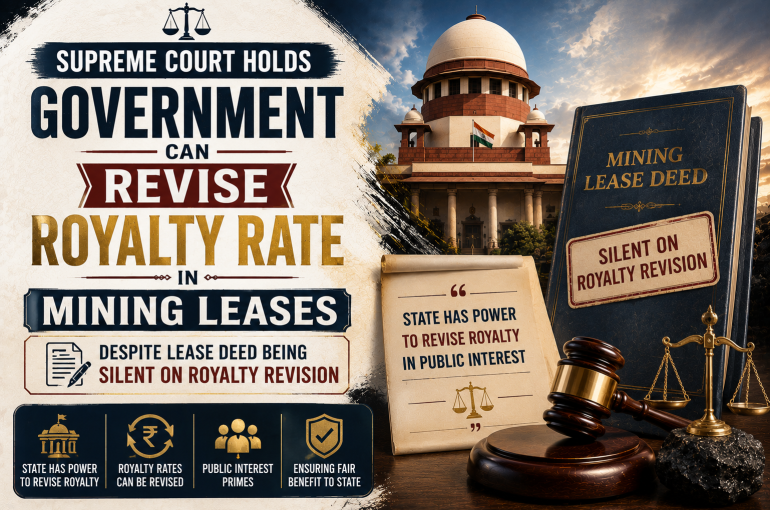
SUPREME COURT HOLDS GOVERNMENT CAN REVISE ROYALTY RATE IN MINING LEASES DESPITE LEASE DEED BEING SILENT ON ROYALTY REVISION

INTRODUCTION
The Hon’ble Supreme Court of India examined a case concerning the power of the State Government to enhance royalty and dead rent rates during the active period of a mining lease, even when the lease deed itself is silent on the matter, namely The State of Haryana & Ors. v. M/s Faridabad Gurgaon Minerals & Anr., 2026 INSC 690. This decision was made on July 13, 2026. The Court, consisting of Hon’ble Justices Dipankar Datta and Satish Chandra Sharma, stated that a mining lease is a statutory grant rather than a simple private contract and the State cannot contractually surrender its regulatory power to revise tariffs. The Court was concerned with ensuring that mineral resources, which are held in trust for the public, yield fair revenue for the exchequer, emphasizing that statutory rules implicitly govern such lease deeds.
BRIEF FACTS
-
This case involves mining leases granted for extracting road metal and masonry stone across various lands in the Faridabad and Rewari districts.
-
The State of Haryana issued an Auction Notice and subsequent Letters of Acceptance (LoA) in 2001, which explicitly stated that the leases would be governed by the Punjab Minor Mineral Concession Rules, 1964.
-
However, the final mining lease deeds executed between the State and the Respondent lessees in September 2002 did not contain any specific stipulation allowing for fluctuating or revised rates of royalty.
-
In June 2005, the State issued a notification under the Mines and Minerals (Development and Regulation) Act, 1957 (MMDR Act), enhancing the rates of royalty and dead rent by 50%.
-
The lessees challenged this hike before the Hon’ble High Court of Punjab and Haryana, which initially ruled in their favor, stating the lessees were not bound by the enhancement since the lease deeds lacked a revision clause.
ISSUES OF LAW
The Hon’ble Supreme Court addressed three key legal questions:
-
Whether the State was precluded from enhancing the rate of royalty after the execution of the lease deed, given the absence of an express stipulation in the deed subjecting it to statutory rules for revised rates.
-
Whether the decision to enhance the royalty by 50% was arbitrary and unsustainable due to a lack of empirical data or a rational basis.
-
Whether the State’s notification to increase the rates was legally invalid due to an alleged violation of the Rules of Business of Government of Haryana, 1977.
ANALYSIS OF THE JUDGMENT
The Hon’ble Supreme Court criticized the High Court’s interpretation of the lease agreements. The Apex Court made the following important observations:
-
Statutory nature of the grant: The Apex Court acknowledged that a mining lease is not merely a private commercial agreement but a statutory grant governed by the MMDR Act and the 1964 Rules.
-
Implied conditions of the lease: The Court emphasized that Rules 10 and 21 of the 1964 Rules, which regulate financial obligations and contemplate tariff revisions, form an implied condition inherent in the lease deed itself, regardless of their physical omission from the document.
-
Preservation of sovereign power: The Supreme Court pointed out that the government cannot abdicate or surrender its statutory and regulatory powers simply by entering into a contract. It suggested that mere silence in a lease deed does not freeze the State’s authority to revise royalties to secure appropriate revenue for the public exchequer.
-
No arbitrariness in enhancement: The Court rejected the lessees’ claim that the 50% hike was arbitrary. The Apex Court noted that the revision came after a gap of approximately five and a half years, falling well within reasonable statutory limits and held that courts should not sit in Appeal over the mathematical wisdom of economic policy decisions.
-
Compliance with business rules: The Court observed that the decision to revise the rates was taken by the Chief Minister, who was also the Minister-in-charge of Mining, satisfying the constitutional necessity of collective responsibility. Furthermore, it noted a deemed consent from the Finance Minister, as no disagreement was recorded on file.
CONCLUSION
The Hon’ble Supreme Court allowed the Appeals filed by the State, setting aside the earlier Judgment of the High Court.
Therefore, the Hon’ble Supreme Court upheld the State’s authority to recover the unpaid dead rent and royalty under the enhanced rates. This ruling reinforces the principle that statutory powers regarding public resources always override contractual omissions. However, to balance the equities given the prolonged litigation and the fact that the leases had already expired in 2009, the Court provided limited relief by capping the interest rate on the arrears owed by the Respondents at 12% per annum.
ANIKET KUMAR PARCHA
Legal Associate
The Indian Lawyer & Allied Services
Please log onto our YouTube channel, The Indian Lawyer Legal Tips, to learn about various aspects of the law. Our latest Video link is in below:

Leave a Reply