



















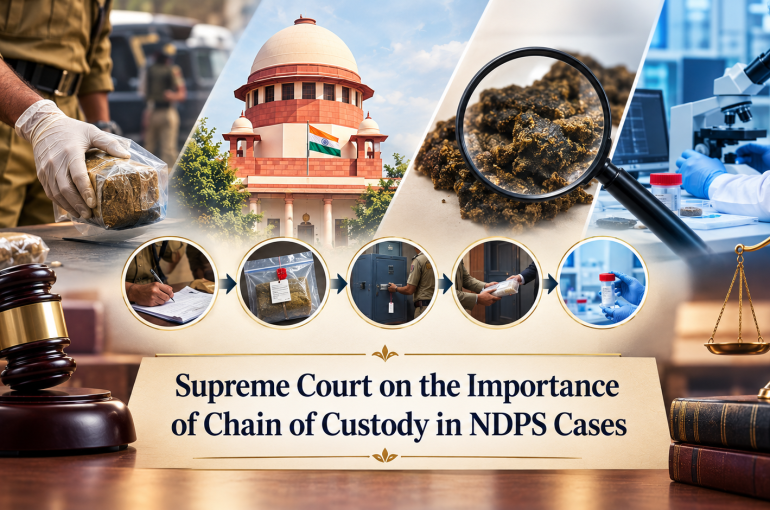
SUPREME COURT ON THE IMPORTANCE OF CHAIN OF CUSTODY IN NDPS CASES

INTRODUCTION
In Abdul Rajik v. State of M.P. and connected matter Govind v. State of M.P., 2026 INSC 1001, the Supreme Court of India delivered an important Judgment on 16 September 2026 concerning the evidentiary requirements in prosecutions under the Narcotic Drugs and Psychotropic Substances Act, 1985 (NDPS Act). The Judgment was delivered by a Bench comprising Justice Sandeep Mehta and Justice Manmohan. The Court examined whether an FSL Report could be relied upon when the Prosecution failed to establish a proper and continuous chain of custody of the samples allegedly drawn from the seized contraband.
The Judgment is particularly important because an NDPS prosecution can have serious consequences for an accused. The Court therefore emphasised that the Prosecution must establish not only the recovery of the substance but also its identity and the integrity of the samples sent for forensic examination.
BRIEF FACTS
The case arose from an incident dated 29 November 2004 in Jabalpur, Madhya Pradesh. The Prosecution alleged that Inspector Rajesh Tiwari received information that two persons were carrying charas in bags. A police team reached Bandariya Tiraha and apprehended Abdul Rajik and Govind. According to the Prosecution, one kilogram of suspected charas was recovered from Abdul Rajik and 800 grams from Govind. Samples were drawn and subsequently sent to the Forensic Science Laboratory (FSL).
The FSL Report stated that the samples were charas. The Trial Court convicted both Accused under the NDPS Act. Abdul Rajik was sentenced to 10 years’ rigorous imprisonment and a fine of Rs.1 lakh, while Govind was sentenced to 8 years’ rigorous imprisonment and a fine of Rs.80,000. Their convictions were subsequently upheld by the Madhya Pradesh High Court.
The Accused then approached the Supreme Court. Among other grounds, they argued that the Prosecution had failed to establish a proper chain of custody of the samples and had not complied with the mandatory safeguards under the NDPS Act.
ISSUES
The principal issues before the Supreme Court were:
- Whether the Prosecution had established the identity of the seized substance as charas through legally reliable evidence.
- Whether the Prosecution had established an unbroken chain of custody from the seizure and sampling of the contraband until its receipt by the FSL.
- Whether non-compliance with Section 52-A of the NDPS Act affected the Prosecution case.
- Whether the FSL Report could be relied upon when the integrity and safe custody of the samples had not been properly established.
ANALYSIS
The Supreme Court first considered the evidence regarding the samples. The Seizure Officer stated that two representative samples of 25 grams each had been drawn. However, the Court noticed that the evidence did not clearly establish that the sample packets themselves carried identifiable signatures, thumb impressions or other marks connecting them with the seized contraband. The sample packets were also not separately produced or exhibited before the Court.
The Court then examined the evidence concerning the movement of the samples. The Maalkhana Witness stated that the samples were deposited on 29 November 2004 and were sent to the FSL on 6 December 2004. However, the Maalkhana Register did not contain a corresponding entry showing the exit of the samples from the police station. There was also no satisfactory evidence showing that the samples remained sealed and secure during this period.
There was an additional and important discrepancy. The forwarding letter was dated 1 December 2004, whereas the FSL Report recorded that the samples were received on 6 December 2004. The Prosecution could not explain where the samples remained during these five days. The Constable who allegedly carried the samples was also not examined as a witness. According to the Supreme Court, this unexplained gap seriously affected the chain of custody.
The Court explained that for an FSL Report to be safely relied upon, the Prosecution must establish through credible oral and documentary evidence that the samples were properly sealed and remained in safe custody from the time of seizure until their receipt at the Laboratory. This is particularly important because the identity of the substance is a basic element in an NDPS prosecution.
The Court also considered Section 52-A of the NDPS Act, which provides safeguards concerning the drawing and certification of representative samples. While the Court noted that every procedural lapse does not automatically result in an acquittal, it found that the present case involved total non-compliance with the statutory procedure. The Prosecution had made no effort to draw representative samples in the presence of a Magistrate.
The Court ultimately held that the link evidence had completely failed. As a result, the FSL Report could not safely be relied upon. Once the FSL Report was excluded, there was no other legally admissible evidence establishing that the recovered substance was charas. The Court also rejected the claim of the Seizure Officer that the substance could be identified as charas merely by burning a portion of it, in the absence of scientific material supporting such identification.
CONCLUSION
The Supreme Court accordingly held that the Prosecution had failed to prove that the substance recovered from the Appellants was charas. The convictions recorded by the Trial Court and affirmed by the High Court were set aside, and Abdul Rajik and Govind were acquitted.
The Judgment highlights an important principle in NDPS prosecutions: recovery alone is not enough. The Prosecution must also establish the identity, integrity and safe custody of the samples relied upon for forensic examination. Any unexplained break in the chain of custody can seriously affect the evidentiary value of the FSL Report. The decision therefore reinforces the need for investigating agencies to strictly follow sampling, sealing, storage and forwarding procedures in NDPS cases.
SARTHAK KALRA
Senior Legal Associate
The Indian Lawyer & Allied Services
EDITOR’S COMMENTS
This is a classic case of justice delayed is justice denied. After having spent approximately 20 years behind the bar, the Accused finally gets a clean due to the fact that the Prosecution could not show chain of custody of proper evidence to prove their case. The question that comes to everyone’s mind is how will the person who spent a valuable part of his life behind bars get compensated for the same.
SUSHILA RAM VARMA
Advocate & Chief Consultant
The Indian Lawyer & Allied Services
Watch our latest video

Leave a Reply