



















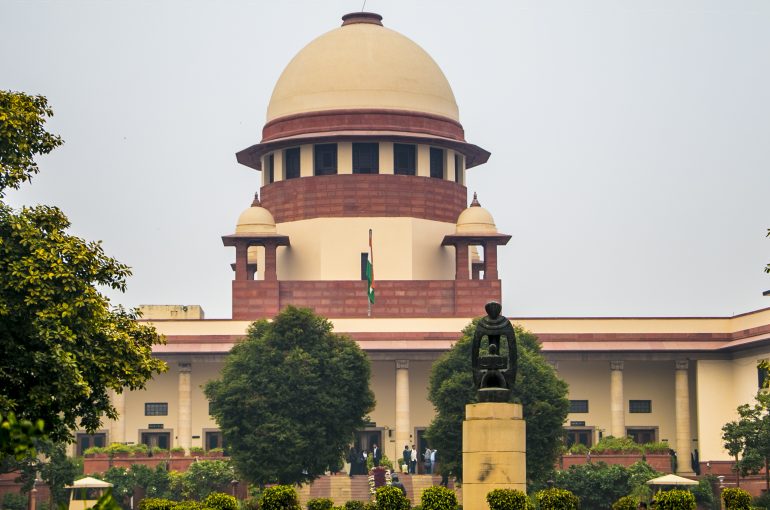
SUPREME COURT UPHOLDS LIFE SENTENCE ON THE BASIS OF SINGLE CREDIBLE WITNESS

INTRODUCTION
In Adalat Yadav & Anr. v. State of Bihar, 2026 INSC 403, decided on 22 April 2026, the Supreme Court of India, comprising Justice Sanjay Karol and Justice Nongmeikapam Kotiswar Singh, reaffirmed a settled but often contested principle of criminal law: a conviction can be sustained on the testimony of a single witness, provided it is of sterling quality.
The Court dismissed the Appeals and upheld the conviction and sentence of the Appellants, emphasising that quality of evidence prevails over quantity and minor inconsistencies or procedural lapses do not necessarily erode the Prosecution’s case.
BRIEF FACTS
The case arose from a violent incident on 4 December 2008, where the deceased was shot dead in broad daylight. The Prosecution case was that the Appellants, along with others, surrounded the deceased and opened fire due to prior enmity arising out of earlier criminal proceedings. The Complainant, who was also injured in the incident, lodged the FIR on the same day.
The Trial Court convicted the Accused under multiple provisions including Section 302 IPC and sentenced them to life imprisonment along with additional sentences under Section 307 IPC and the Arms Act. The High Court upheld the conviction, though it discarded several eyewitnesses and relied primarily on the testimony of the injured Complainant. This formed the basis of challenge before the Supreme Court.
ISSUES OF LAW
The Supreme Court was required to consider whether the conviction could be sustained despite doubts raised about multiple eyewitnesses, alleged delay in FIR, inconsistencies between medical and ocular evidence and absence of independent witnesses.
ANALYSIS OF THE JUDGMENT
The Supreme Court approached the matter by first reiterating that interference under Article 136 is limited, particularly where there are concurrent findings of fact. It therefore confined itself to examining whether any manifest error existed in the appreciation of evidence by the courts below.
A central aspect of the Judgment is the Court’s reaffirmation that conviction can rest on the testimony of a single witness, provided such testimony is credible, consistent and trustworthy. The Court noted that while the High Court had discarded four eyewitnesses, it found the testimony of the Complainant to be reliable. Being an injured witness, his presence at the scene was unquestionable and his account carried greater evidentiary weight.
The Court elaborated on the concept of a “sterling witness”, observing that such a witness must present a consistent, natural and unshaken version of events that withstands cross-examination and aligns with the overall case of the prosecution. Applying this standard, the Court found that the Complainant’s testimony satisfied the required threshold.
While dealing with the contention regarding delay in filing the FIR, the Court observed that mere delay does not, by itself, undermine the Prosecution case unless it creates a genuine doubt of concoction or fabrication. In the present case, since the FIR was registered on the very same day and no evidence was brought on record to indicate prejudice or manipulation, the delay was held to be inconsequential.
On the alleged contradiction between medical and ocular evidence, the Court observed that both sets of evidence consistently indicated that the deceased had been shot in the head. Any variation in description of the exact point of entry or exit of the bullet was held to be immaterial. The Court reiterated the settled principle that ocular evidence, particularly of a credible eyewitness, prevails over medical opinion unless the latter completely rules out the Prosecution version.
The Court also rejected the contention regarding non-examination of independent witnesses, noting that in cases involving violent crimes and local enmity, reluctance of independent persons to come forward is a natural phenomenon. The absence of such witnesses does not, by itself, weaken the Prosecution case.
Ultimately, the Court concluded that the testimony of the Complainant, corroborated by surrounding circumstances, was sufficient to establish the guilt of the Appellants beyond reasonable doubt.
CONCLUSION
The Supreme Court dismissed the Appeals and affirmed the conviction and life sentence of the Appellants. It held that the Prosecution had successfully established its case on the strength of reliable evidence, notwithstanding minor inconsistencies or absence of multiple eyewitnesses.
This Judgment reinforces a fundamental principle of criminal jurisprudence: it is the quality, not the quantity of evidence that determines guilt. By upholding conviction based on the testimony of a single credible witness, the Court has reiterated that truthful and trustworthy evidence, even if singular, is sufficient to sustain a conviction in law.
SARTHAK KALRA
Senior Legal Associate
The Indian Lawyer & Allied Services
Please log onto our YouTube channel, The Indian Lawyer Legal Tips, to learn about various aspects of the law. Our latest Video, titled “What to do when false FIR/case filed against you? How to deal with false cases” can be viewed at the link below:

Leave a Reply